

· AFX Research, LLC
How a Signed Document Becomes a Public Record, and Why It Lags
The path from a signature to a searchable index entry, the checks a filing office does and does not make, where the delay collects, and why an index line is not proof.
Table of Contents
A deed gets signed at a kitchen table on a Tuesday. Whether anybody searching that property on Wednesday can see it is a separate question, and the distance between the two explains a good share of the surprises in this work.
Recording is a process with steps, and most of the steps have a queue.
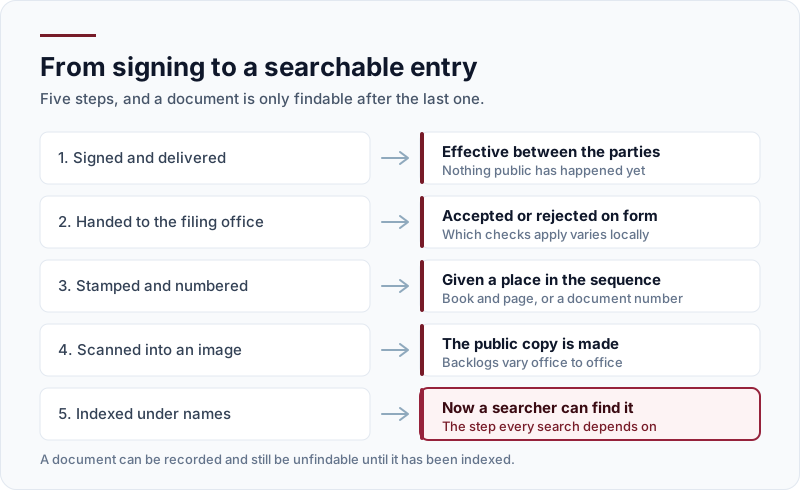
From signing to a searchable entry
The document is signed and delivered, at which point it binds the people who signed it and is invisible to everyone else. It is presented to the filing office, which accepts or rejects it on form. It is stamped and given a place in the sequence. It is scanned, which produces the copy the public sees. Then it is indexed under names, which is the step that makes it findable.
Only the last one puts a document within reach of a search. Something can be properly recorded on Monday and still return nothing on Tuesday, because nobody has keyed it.
What the office checks, and what it does not
The review at the counter is clerical, not substantive. The office checks that the document is the right kind of thing filed the right way. Legibility, margins, a notary acknowledgment, the recording fee, and in many places a transfer tax declaration. Which checks apply varies by state and by office, and a document turned away in one county can be accepted in the next.
What the office does not do is test whether any of it is true. Nobody confirms that the signer owned anything, that the legal description matches the ground, or that the instrument accomplishes what it claims. It is an archive with a clerk at the door. That is the root of what a recorder does not hold, and it is why a recorded document is evidence that something was filed rather than proof that it worked.
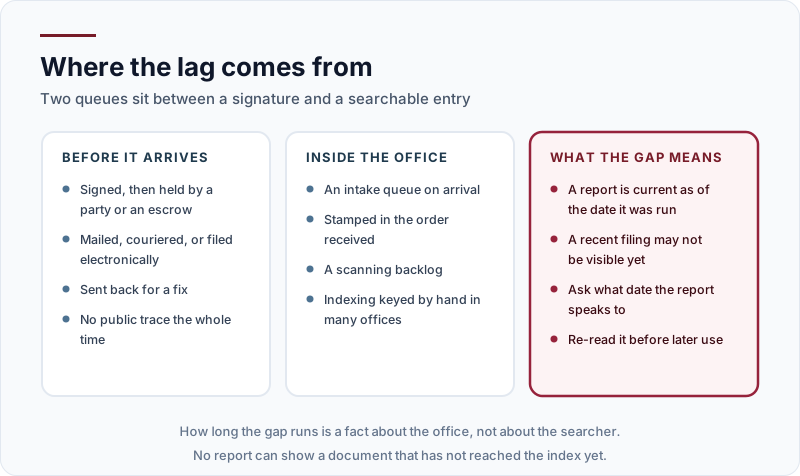
Where the lag collects
Two queues, and then a date.
The first queue sits before the office ever sees the document. It waits with a party or a closing agent, gets mailed or filed electronically, and sometimes comes back for a correction. None of that leaves a public trace. The second runs inside the office, from intake through stamping and scanning to indexing, which in many offices is still typed in by a person.
Electronic recording has compressed this where it has been adopted, sometimes to the same business day. Elsewhere the queue is measured in weeks. Both are ordinary, and the length is a fact about that office rather than about the searcher.
The date is the third piece. A report speaks as of the moment it was run, and a document sitting in either queue is not in it. That is not a flaw, as long as the report says so.
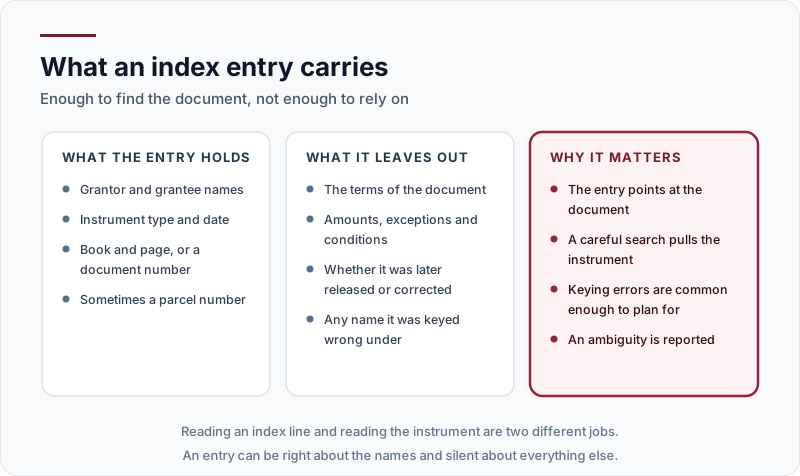
What the index entry carries
An entry holds grantor and grantee names, a document type, a recording date, a book and page or document number, and sometimes a parcel number. That is a finding aid. It is not the document.
It does not carry the terms, the amounts, the exceptions, or whether it was later released or corrected. And because a person keyed it, it can be wrong in the way that hurts most, indexed under a name nobody would think to search. That failure mode is the heart of what happens when the record is wrong.
The working discipline is easy to state. Pull the instrument instead of quoting the line, and where two readings are both available, report the ambiguity rather than quietly picking one.
Why any of this changes an answer
A search reads named indexes in named offices over a stated period, as of a date. Every limit above lands somewhere in that sentence, which is why a useful report states all four and a reassuring one states none.
It is also why the work is organized by place. Whoever reads a county for one of our searches has usually read it before and knows where its gaps are, which is not the same as remote access. The network is split by state for that reason.
The takeaway
A signature creates an agreement. Recording puts a copy in an archive. Indexing is what finally makes it findable, and the distance between those three moments is measured in queues that vary by office. Knowing that lets you read a report for what it says, which is what was found in named records up to a stated date, rather than as a verdict on the land.
Find the property that runs your search, or tell us what you are trying to establish and we will point you at the right one before anything is ordered.