

· AFX Research, LLC
What a Public Records Request Is, and When a Search Needs One
Recorded land documents are open to anyone who walks in. Most other government files come out through a written request, on a different clock and with different limits.
Table of Contents
People use “public records” to mean one thing and government uses it to mean two. Recorded land documents sit in an index that anyone may inspect without asking permission or giving a reason. Almost everything else a government holds about a property comes out through a written request that an agency processes on a statutory clock. Knowing which route a given answer lives on saves a great deal of time, and it explains why a thorough title search can be silent on questions that feel obviously public. What the recorder does not hold maps the same boundary from the other side.
Two different kinds of open
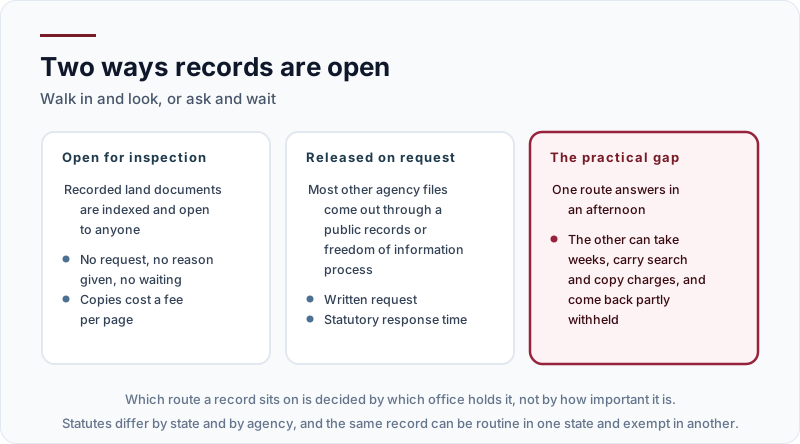
The recording office is built for inspection. Its whole purpose is to give the world notice of what has been filed against land, so the index is open, the documents are open, and copies cost a per page fee. An abstractor walks in, works the index and leaves with instruments the same day.
A records request is a different machine. Under a state public records act, or the federal Freedom of Information Act for federal agencies, a person asks in writing and the agency responds within a period the statute sets. It may charge for search time and copying, and it may withhold material that falls under an exemption.
The gap between the two is practical rather than philosophical. One route answers in an afternoon. The other can take weeks and come back partly redacted. Which route a record sits on is decided by which office holds it, and statutes differ by state and by agency, so a file that is routine in one state is exempt in the next.
That timing difference is the part that catches people inside a transaction. A buyer who discovers on day eighteen of a thirty day diligence period that the answer needs a records request has usually already run out of calendar, which is the argument for starting both routes at once rather than in sequence.
When a request is the thing you actually need
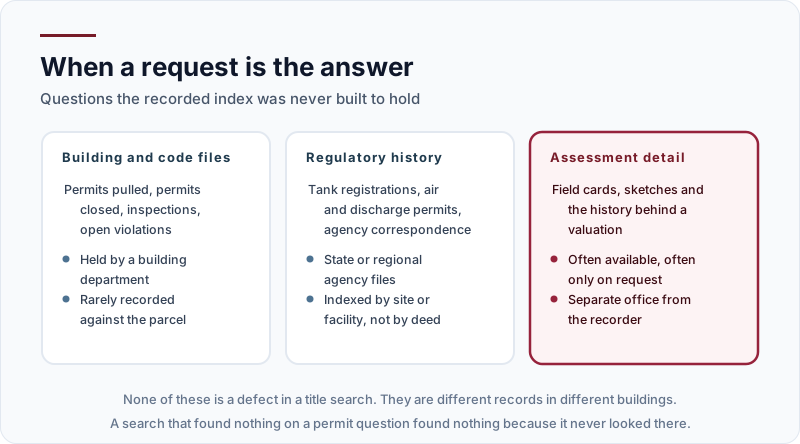
Three categories come up constantly.
Building and code files. Permits pulled, permits closed, inspection results and open violations live with a building department. Unless a municipality recorded a notice of violation against the parcel, none of it is in the land record.
Regulatory history. Tank registrations, air and discharge permits, and correspondence with an environmental agency are held by state or regional bodies and indexed by site or facility rather than by deed.
Assessment detail. The property card, the sketch and the reasoning behind a valuation are frequently available, often only on request, and from a different office than the recorder.
None of these is a gap in a title search. They are different records in different buildings, and what a title search is not is largely a list of them.
Making a request that works
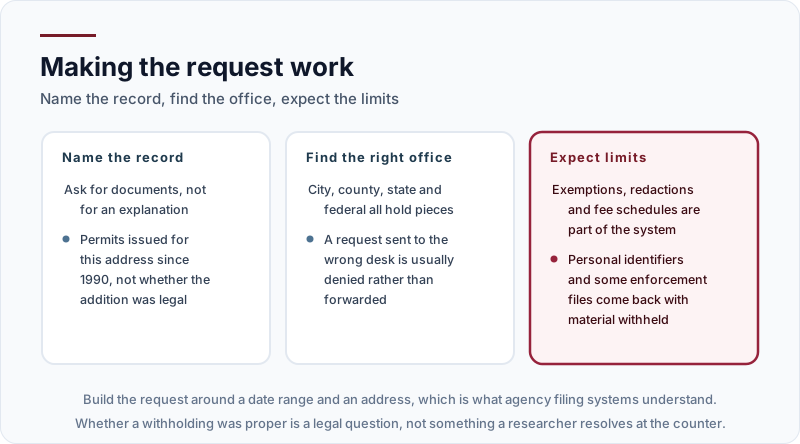
Ask for documents rather than for an explanation. “All permits issued for this address since 1990” is a request an agency can fill. “Whether the addition was legal” is a question it will decline to answer, and reasonably so.
Address it to the office that holds the file. City, county, state and federal agencies each keep their own, and a request sent to the wrong desk is usually denied rather than forwarded. Then expect limits, because exemptions, redactions and fee schedules are part of the design rather than obstruction. Personal identifiers and some enforcement files come back with material withheld, and whether a withholding was proper is a legal question rather than something settled at a counter.
The takeaway
Use the recorded index for what was filed against the land, and a records request for what an agency did about it. Our services page sets out which of those we work in. Find the property that runs your search, or tell us what you are trying to establish and we will point you at the right one before anything is ordered.