

· AFX Research, LLC
What a Notary Acknowledgment Proves, and When It Fails You
What the notary block on a recorded deed actually certifies, the three ways it goes wrong, and what a defective acknowledgment does to notice further down the chain of title.
Table of Contents
Every recorded deed carries a short paragraph at the bottom that almost nobody reads. It says a named person appeared before an officer, was identified, and acknowledged the signature as their own act. That paragraph is the gate between a private piece of paper and the public record, because recording statutes in essentially every state require it before a clerk may accept an instrument at all. It is also the most commonly defective part of an old deed.
What the certificate actually says
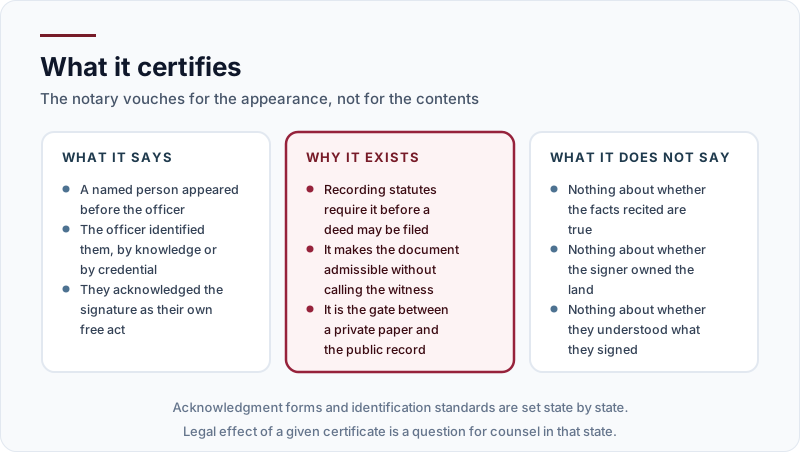
The notary vouches for the appearance. Somebody stood there, was identified by personal knowledge or by credential, and said the signature was theirs and freely given. That is the whole of it.
The certificate says nothing about whether the facts recited in the document are true, nothing about whether the signer owned the land, and nothing about whether they understood what they were signing. Those are separate questions, answered by other means or not at all. Acknowledgment forms and identification standards are set state by state, so the certificate on a 1952 Ohio deed does not look like the one on a 2024 Arizona deed, and neither resembles a remote online notarization.
Three different kinds of failure
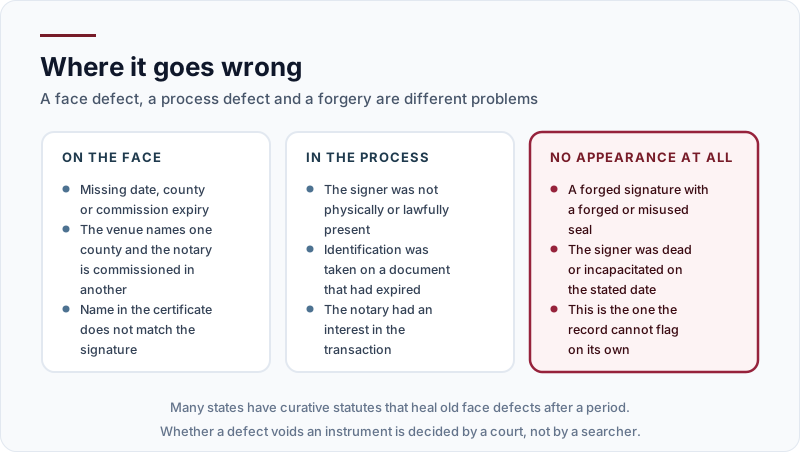
On the face. A missing date, a missing county, an expired commission, a venue naming one county when the notary was commissioned in another, or a name in the certificate that does not match the signature. These are visible to anyone reading the instrument, which is why a search can flag them.
In the process. The signer was not lawfully present, identification was taken on an expired document, or the notary had an interest in the transaction. Nothing on the face reveals any of this.
No appearance at all. A forged signature with a forged or misused seal, or a certificate dated after the signer had died. This is the category that drives deed fraud, and the record cannot flag it on its own, because a well-made forgery looks exactly like a good deed.
What a defect does to the chain
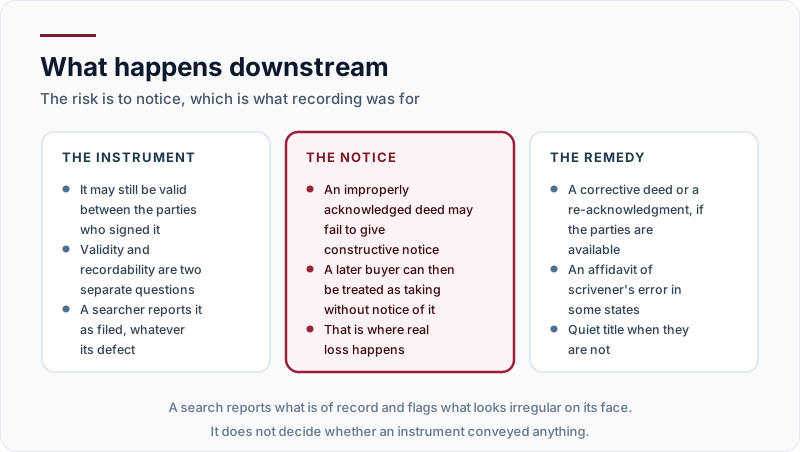
Validity and recordability are two different questions. A deed with a botched notary block may still be perfectly good between the two people who signed it. The risk is to notice. Recording exists to put the world on notice, and an improperly acknowledged instrument may fail to give the constructive notice that recording normally supplies. A later buyer can then be treated as having taken without notice of it, and that is where actual loss happens rather than in the paperwork.
Most states have curative statutes that heal old face defects after a period of years, on the sensible theory that a deed sitting quietly in the record for four decades should not be unwound over a missing county name. How long that period runs, and which defects it reaches, differ by state. Whether any particular defect voids an instrument is decided by a court, not by a searcher. The remedy, when the parties are still available, is usually a corrective deed or a re-acknowledgment, and a correction in the record is how that lands back in the index.
What a search does with it
A search reports the instrument as it was filed, whatever its condition, and notes an irregularity that is visible on the face. It does not decide whether the deed conveyed anything. That reflects the general shape of the thing, which is that a title search is not a legal opinion and never has been. The abstractor’s job is to put the instrument in front of the person who has to make the call, which is one of the reasons the services are organized around research rather than around opinions.
The takeaway
Read the notary block on anything that looks important. A face defect is findable and frequently cured by statute, a process defect is invisible, and a forgery is the one that costs money. What matters downstream is almost never whether the deed was good between the parties, but whether recording it put anyone on notice.
Find the property that runs your search, or tell us what you are trying to establish and we will point you at the right one before anything is ordered.