

· AFX Research, LLC
What an Index Is, and Why It Decides What a Search Finds
A filing office stores documents and indexes them separately. The index is what a searcher can actually reach, and the way it is built changes the answer.
Table of Contents
People picture a title search as somebody reading through a county’s documents. That is not what happens, and the difference explains most of what is otherwise puzzling about this work — why one county takes longer than another, why a name has to be exactly right, and why a recorded document can be invisible. A search does not read the records. It reads the index, and the documents follow from what the index points at. It is the mechanism underneath how a document becomes a public record.
Two ways to index the same filing
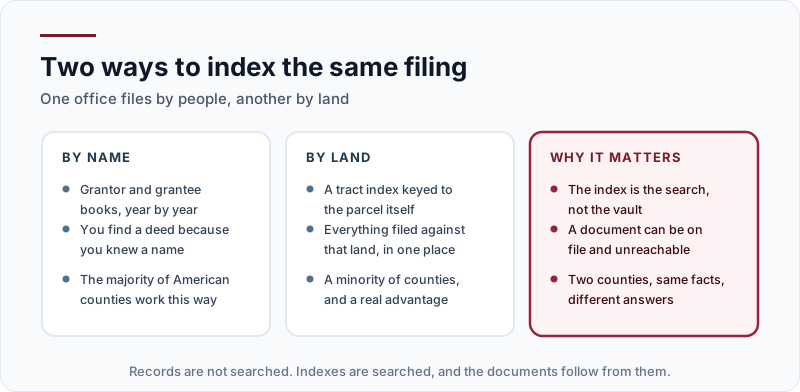
Most American counties index by grantor and grantee — by the people on each side of a transaction. Two running lists, organized by name and by year, with a reference to where the document itself sits. You find a deed because you already knew a name to look for.
A minority keep a tract index as well, organized by the land. Everything filed against a parcel appears in one place, regardless of who signed it, which is a considerable advantage and is why searches in those counties can answer questions the others cannot.
The practical point is that the index is the search. A document can be properly executed, properly recorded, sitting safely in the vault, and still be unreachable because nothing in the index leads to it. Two counties holding identical facts can return different answers, purely because of how each one is organized. That is a large part of why recording practice is local.
Walking a chain by name
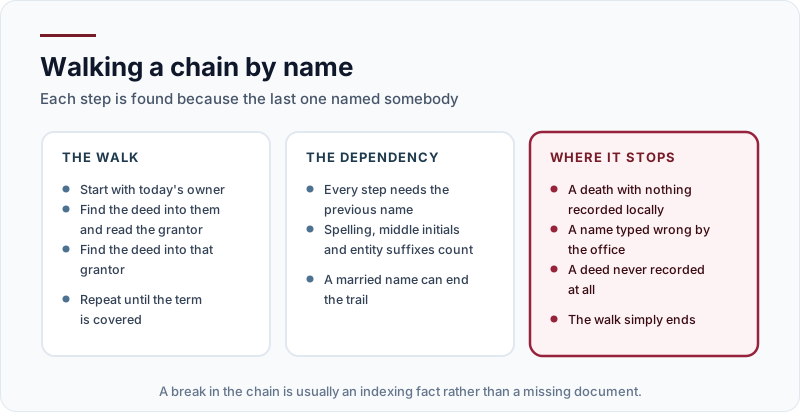
In a name index the work goes backward in steps. Start with the current owner, find the deed that put them on title, read the grantor’s name off it, then find the deed that put that person on title. Each step is found only because the previous step supplied a name to look for.
Which means every step depends on a name being right. Spelling, middle initials, entity suffixes, and married names all matter, because the index sorts on exactly what was typed into it. A woman who took title under one surname and conveyed under another is a break unless somebody knows to connect them.
The walk can stop for reasons that have nothing to do with anyone’s diligence. A death where nothing was recorded locally, a name mistyped by the office decades ago, or a deed that was never recorded at all. In each case the document may exist and the trail still ends, which is the situation described in what happens when the public record is wrong.
What makes an index search work
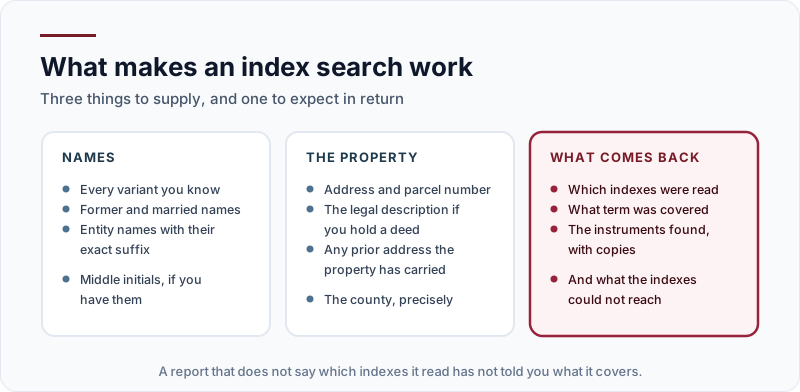
Supply names generously. Every variant you know of, former and married names, entity names with their exact suffix, middle initials where you have them. Each one is another way into the index, and the cost of supplying a name that turns out to be irrelevant is nothing.
Supply the property precisely as well. Address, parcel number, the legal description if you hold a deed, and any prior address the property has carried. All of it helps confirm the search landed on the right ground before the real work starts.
Then expect the report to say what it reached. Which indexes were read, what term was covered, what was found, and what those indexes could not reach. A report that does not state its scope has not told you what it covers, which is the point our note on what a search is not keeps returning to.
The takeaway
The index is the instrument, and it shapes the answer more than the vault does. Ask which indexes a search will read and over what term, give whoever is searching every name and identifier you have, and read the scope statement before the findings. Find the property that runs your search, or tell us what you are trying to establish and we will point you at the right one before anything is ordered.