

· AFX Research, LLC
What County Recording Fees Pay For, and Why They Vary by Office
Why the same two-page deed costs one amount in one county and three times that next door, what a recording fee actually buys, and what the stamp on it does not mean.
People running their first search are usually surprised twice. Once by how little it costs to put a document into the public record, and again by how differently two neighboring offices price the same work. Both reactions come from the same place, which is an assumption that a recording fee is a price for a service. It is closer to a tax schedule with a filing clerk attached.
What the fee pays for
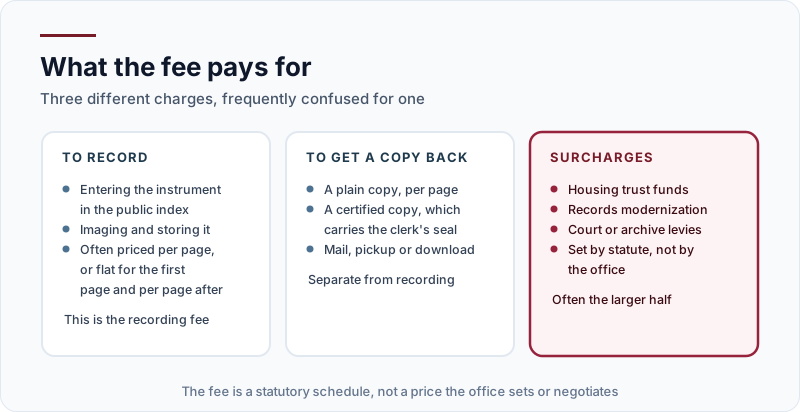
Three charges get bundled together in most people’s heads, and they are distinct.
Recording is the act of entering an instrument into the public index, imaging it and storing it. It is usually priced per page, or as a flat amount for the first page plus a per-page rate after that.
Copies are separate. A plain copy is priced per page, and a certified copy carries the clerk’s seal and costs more, which matters because a certified copy is what carries evidentiary weight, as what a certified copy of a record proves explains.
Surcharges are frequently the larger half of the bill, and they fund things that have nothing to do with land records — housing trust funds, records modernization programs, court levies, archive funds. They are set by statute rather than by the office collecting them.
Why two offices differ
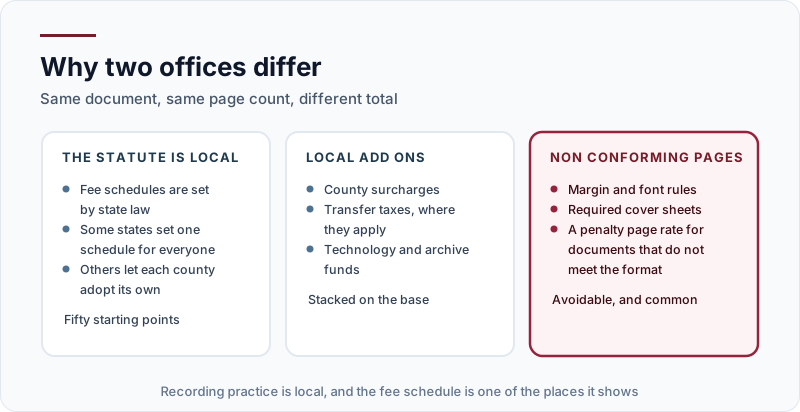
Fee schedules are set by state law, so there are fifty starting points before anything local happens. Some states publish one schedule that every county uses. Others set a floor and let each county adopt its own.
On top of that sit county surcharges, transfer taxes where they apply, and technology or archive funds adopted locally. The result is that the same deed, with the same page count, can cost three or four times as much in one county as in the one next to it, and neither office is doing anything unusual.
Formatting is the avoidable part. Most offices publish margin, font and cover sheet requirements, and many charge a penalty rate for a non-conforming page. A document rejected or surcharged for formatting is a self-inflicted cost, and it is one of the practical reasons recording practice is local is worth knowing before you file rather than after.
Delivery changes the number too. An office with an e-recording channel generally returns a stamped document the same day, and one that takes paper by mail may take weeks to return it, with the recording effective from receipt rather than from when the envelope comes back. Where a vendor sits in the middle of an e-recording submission, their charge is a third line item that has nothing to do with the county at all.
What the fee does not buy
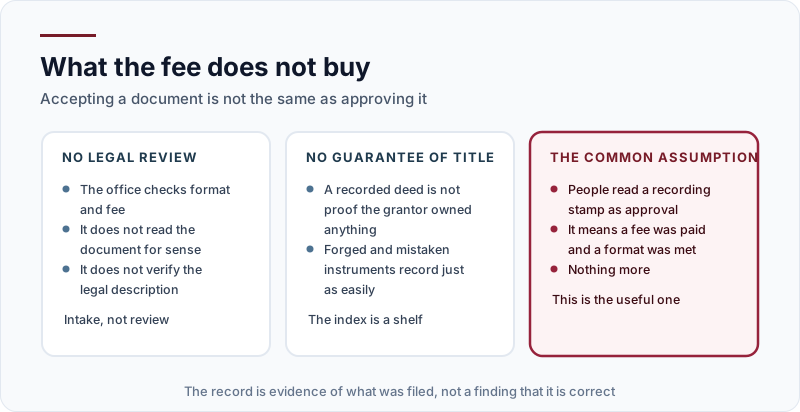
This is the part that matters most to anyone reading a chain. The office checks that the document meets the format and that the fee has been paid. It does not read the instrument for sense, verify the legal description, confirm that the grantor owned anything, or form any view about whether the document does what it says.
A recording stamp is therefore evidence that something was filed on a date, and nothing more. Forged deeds, mistaken descriptions and instruments signed by people with no authority all record exactly as easily as correct ones, which is why what a title search is not keeps drawing the line between the record and the truth.
The same reasoning explains the fee structure itself. If the office were vouching for content, the charge would scale with the difficulty of reviewing a document. It scales with page count instead, because page count is what the office is actually handling, and that is a reasonable proxy for storing and imaging paper rather than for anything about the transaction.
The takeaway
The fee is a statutory schedule, the schedule is local, and the stamp it buys is an intake receipt rather than an endorsement. None of that makes the record less useful. It makes it a specific kind of evidence — what was filed, by whom, and when — which is exactly what a search reports and exactly what it stops at. Find the property that runs your search, or tell us what you are trying to establish and we will point you at the right one before anything is ordered.