

· AFX Research, LLC
What Else Is in the Land Record Besides Deeds and Mortgages
Liens, easements, leases, affidavits and personal filings all share one index, why they do, and how the breadth of the record shapes what a search returns.
Table of Contents
Ask most people what a county recorder holds and they will say deeds. Deeds are a minority of the volume and frequently not the part that decides a transaction. The same index carries claims, rights, restrictions and a scattering of personal documents that have nothing to do with a transfer, and knowing the range is what turns a search from a lookup into an answer. Our note on what the recorder does not hold draws the other edge of the same boundary.
Four families of filings
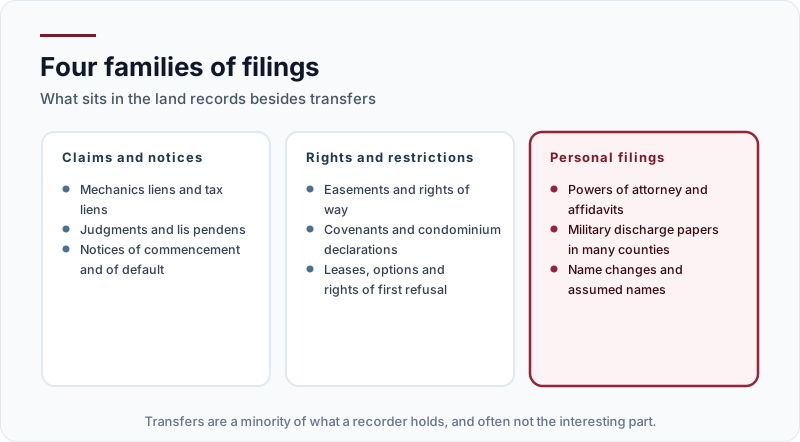
Claims and notices are the largest group after transfers. Mechanics liens, tax liens, judgments, lis pendens, notices of commencement and notices of default all live here, each one a warning rather than a conveyance.
Rights and restrictions are the second. Easements and rights of way, covenants and condominium declarations, and leases, options and rights of first refusal. None of them move ownership, and all of them change what an owner can do.
The third group surprises people. Powers of attorney, affidavits of all kinds, military discharge papers in a great many counties, name changes and assumed name certificates. They are there because the recorder is the county’s permanent, publicly searchable filing cabinet, and somebody needed a document to be both.
Why they share one index
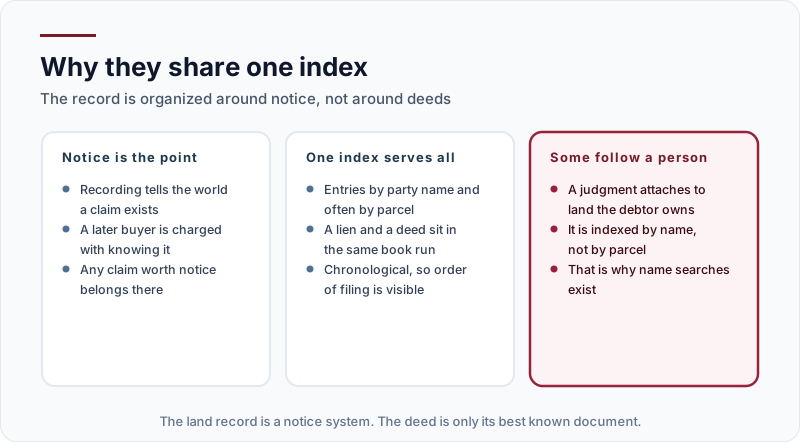
Because notice is the point. Recording exists to tell the world that a claim exists, and a later buyer is charged with knowing whatever the record would have shown. Any claim worth that protection belongs in the same place, whatever its shape.
One index therefore serves them all. Entries run by party name and often by parcel, a lien and a deed sit in the same book run, and the sequence is visible because filings are numbered as they arrive. That shared chronology is what makes priority readable.
Some filings follow a person rather than a parcel. A judgment attaches to land the debtor owns, so it is indexed by name, and nothing ties it to a description until somebody connects the two. That is the reason name searches exist alongside parcel searches, a split our note on name searches and parcel searches works through.
What recording does not decide
Being in the land record does not make a document true, valid or enforceable. The recorder’s office is not asked to pass on any of that. Staff check that an instrument meets the formal requirements, collect the fee, stamp it and index it, and the content is the filer’s responsibility. A lien recorded by somebody with no right to file one goes into the same index as a legitimate one and looks identical there.
That is why finding a document is the beginning of the work rather than the end of it. The search establishes that a claim was asserted, when, by whom, and against what. Whether it holds up is a separate question, answered by reading the instrument against the law of that state, and it is a question for a lawyer rather than for an abstractor. Our note on what a title search is not sets out where that line sits.
What that means for a search
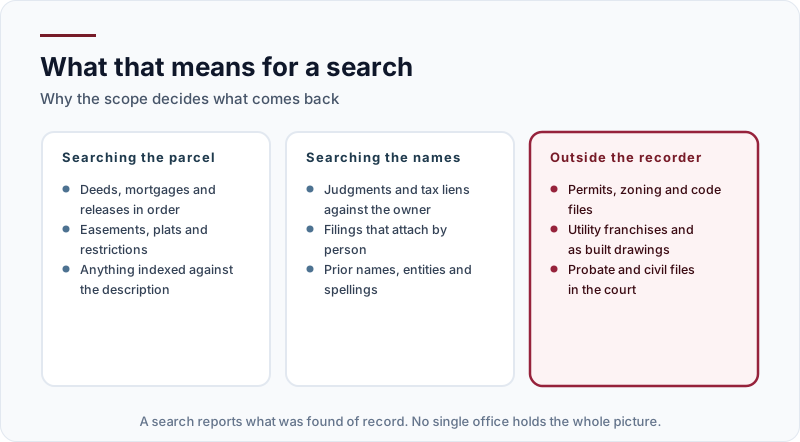
A parcel search returns the deeds, mortgages and releases in order, the easements, plats and restrictions, and anything else indexed against the description. A name search adds the judgments and tax liens standing against the owner, plus the filings that attach by person, and it has to run prior names, entities and spellings to be worth anything.
Outside the recorder sit permits, zoning and code files, utility franchises and as built drawings, and the probate and civil files in the court. Those affect a property and are not in the land record at all.
Recording and indexing practice varies by county, so nothing here holds everywhere. A search reports what was found of record over the scope it covered, and no single office holds the whole picture.
The takeaway
Scope the search to the question. If the worry is ownership, the parcel chain answers it; if the worry is debt, the names do; and if the worry is what can be built, the answer is in an office the recorder does not control, as our note on what the record says about a building explains. Find the property that runs your search, or tell us what you are trying to establish and we will point you at the right one before anything is ordered.