

· AFX Research, LLC
What Happens When a Recorder Rejects a Document at the Counter
Refused filings are routine, they leave no trace in the index, and the gap they open between signing and recording is one reason two dates rarely match.
Table of Contents
A county recording office is a filter, not a judge. It checks whether a document may be filed, collects the fee and the tax, stamps it and puts it in the index. What it does not do is decide whether the document is true, effective or a good idea. That narrow job still produces a surprising amount of friction, because a filing that fails the form check is handed back, and the clock starts again. How a document becomes a public record covers the accepting side of the counter.
Why a filing gets refused
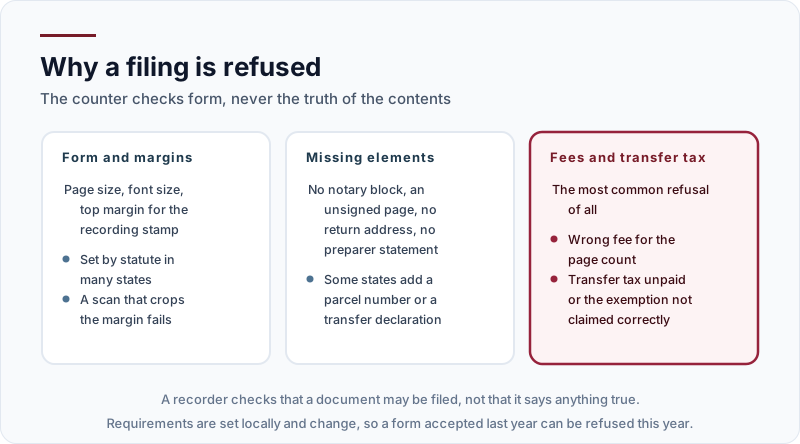
Three families of problem account for nearly all of it.
Form. Page size, font size and a clear top margin for the recording stamp are set by statute in many states, and a scanned copy that crops a margin by a quarter inch will come straight back.
Missing elements. No notary block, an unsigned page, no return address, no statement naming who prepared the instrument. Several states add their own requirements, such as a parcel identification number on the first page or a transfer declaration accompanying a deed.
Fees and transfer tax. This is the most common refusal of all, and it is rarely about anybody being careless. The fee depends on the page count, exemptions from transfer tax have to be claimed in the right words on the right line, and the rules are local. A single exemption claimed on the wrong line will send a deed back twice.
Requirements change. A cover sheet accepted in one county is rejected in the next, and a format that worked last year can fail after a statute or a vendor system changes. That is one of the plainer illustrations of why recording practice is local.
The gap a rejection opens
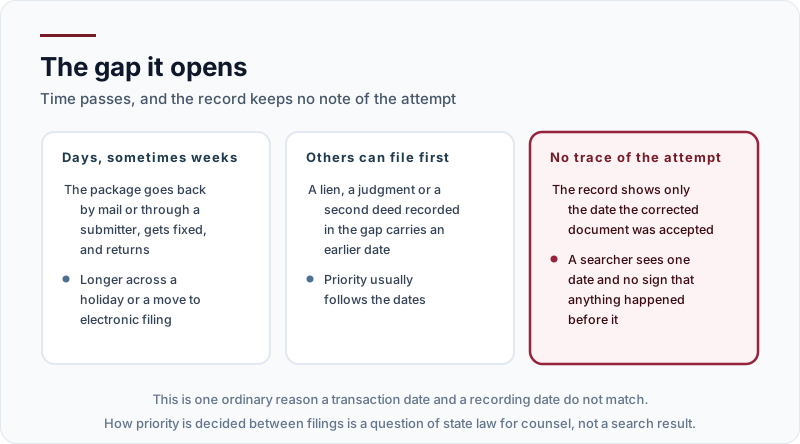
A refused package goes back to the submitter, gets corrected and returns. That round trip takes days and sometimes weeks, longer across a holiday or during a county’s move to electronic filing.
In the meantime the record keeps moving. A judgment, a lien or a second deed filed during the gap carries an earlier date than the corrected instrument, and in most states priority follows the order of recording rather than the order of signing. How that contest resolves is a question of state law for counsel. What matters here is simply that the gap is real and is created by paperwork rather than by anyone’s intention.
Electronic filing has narrowed the gap in the counties that use it, because a submitter often learns within the hour rather than in a week’s mail. It has not closed it. The checks are the same checks run by the same rules, and a package that fails them still waits for a correction before it enters the index at all.
What a search can see afterwards
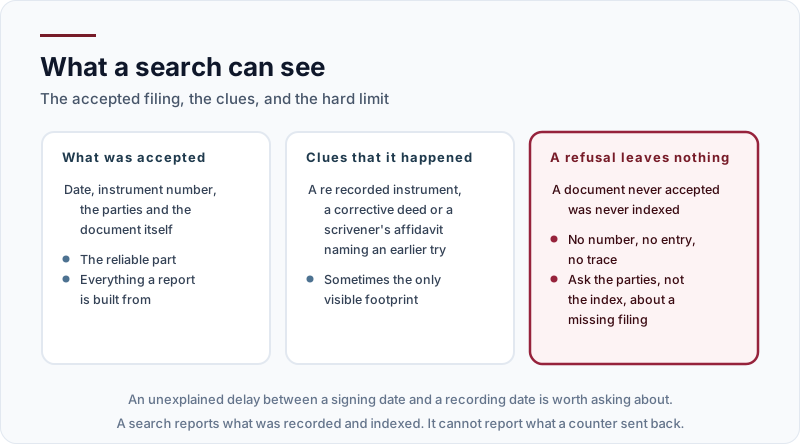
A search reads the index, and the index holds only what was accepted. The accepted instrument, its date, its number and the parties are solid ground, and a report is built from them.
Clues sometimes survive. A re recorded instrument, a corrective deed or a scrivener’s affidavit referring to an earlier attempt will name the history, and a notary date months ahead of a recording date is worth asking about. But a document that was never accepted was never indexed, so there is no number, no entry and nothing to find. When a filing is genuinely missing, the parties and the closing file hold the answer, not the record.
The practical consequence for anyone ordering a search is that the index is a record of filings, not of intentions, and the dates in it are filing dates. Our services page describes what a search covers from there.
The takeaway
A rejected filing is ordinary administrative friction with real consequences for dates and priority, and it is invisible in the record it delayed. Find the property that runs your search, or tell us what you are trying to establish and we will point you at the right one before anything is ordered.