

· AFX Research, LLC
What Is Restricted in the Public Record, and Why It Varies
Which land records are open to anyone, what gets sealed or redacted and by whom, why access differs so sharply between counties, and what that does to a search.
Table of Contents
The land record is public, and that word does more work than it can carry. It is public in the sense that anybody may ask to see most of it. It is not public in the sense that everything is available, to everyone, in the same form, everywhere. There are holes cut into it deliberately, more holes than there used to be, and the pattern of holes is different in every state.
That matters to anyone relying on a search, because an absence in a report can mean several different things.
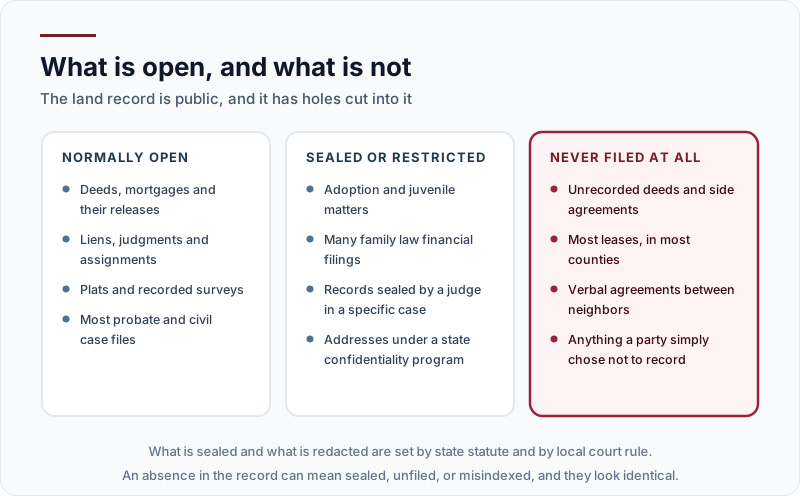
Three different kinds of absence
The first is restricted. The document exists and was filed, and a rule keeps some or all of it from general view. Adoption and juvenile matters are the clearest examples, along with financial affidavits in family law cases and anything a judge has sealed in a particular case.
The second is redacted. The document is available but pieces have been removed. Social security numbers went first, then account numbers, then in many states dates of birth, and in some places signatures.
The third is never filed. No rule is hiding it, because there is nothing to hide. Recording is largely voluntary in the United States, so an unrecorded deed, a side agreement between siblings, or a lease that never produced a memorandum simply is not there. This is the largest category by a wide margin, and it is why what the recorder does not hold matters as much as what it does.
From the outside all three look identical. So does a fourth possibility, which is that the instrument is there and was indexed under something nobody searched.
Why it varies so much between places
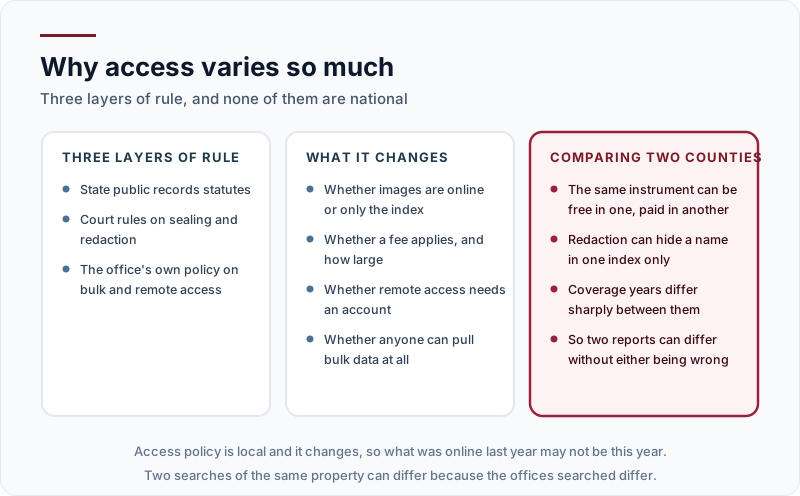
Three layers of rule stack up, and none of them are national. State public records statutes set the baseline of what is open. Court rules govern sealing and redaction, and they are frequently set at the state judicial level rather than by legislature. Then each office decides its own policy on remote access, bulk data and fees, within whatever discretion it has.
The practical effects are large. In one county every deed image since 1950 is free online. In the county next door the index is online but images require a visit or a per-page fee, and coverage stops at 1986. Neither office is doing anything wrong. They are operating under different rules and different budgets, which is the same reason two searches can return different answers without either being defective.
What redaction does to name searching
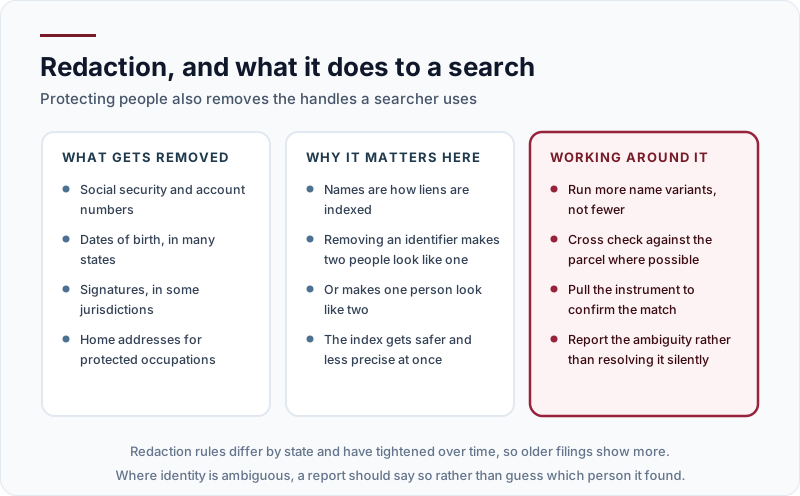
There is a genuine tension here worth being honest about. Liens and judgments are indexed under names, and names are a terrible unique identifier. The things that used to disambiguate them, principally dates of birth and partial identifiers, are exactly what privacy rules have removed.
The protection is the right call. The side effect is that an index gets safer and less precise at the same time. Two people with the same common name become harder to tell apart, and a single person with an inconsistent middle initial can look like two. A search either runs more variants and reports more possible matches, or runs fewer and misses things.
The honest way through is to widen the name coverage, cross-check against the parcel wherever the record allows it, pull the actual instrument to confirm a match rather than relying on the index line, and then report an ambiguity as an ambiguity. A report that quietly picks one interpretation is more comfortable to read and considerably less useful.
What this means for reading a report
An empty result is a statement about the search rather than about the land, and restricted records are one of the reasons why. When a report says nothing was found, the useful follow-up questions are which offices were read, over what period, under which names, and what the report explicitly excludes. A report that answers those is doing its job. A report that states no scope is not really telling you anything at all.
The takeaway
Public does not mean complete, and the gaps are not uniform. Some records are sealed, some are redacted, most of what affects land was never recorded in the first place, and the rules differ at the state line and sometimes at the county line. Knowing which kind of absence you are looking at is most of what separates a useful report from a reassuring one.
Find the property that runs your search, or tell us what you are trying to establish and we will point you at the right one before anything is ordered.