

· AFX Research, LLC
Why a Title Search Has an Effective Date, and What It Misses
Every report describes the record as of a moment rather than as of today. Where that date comes from, why a gap exists behind it, and how to cover the window.
Table of Contents
Somewhere on every search report there is a date, and it is doing more work than almost anything else on the page. It is not the day the report was typed and it is not the day you read it. It is the day the record was looked at, and everything the report says is true as of that moment and makes no claim about any moment after it. People who understand what a title search is not still routinely miss this one, because a report reads like a description of a property when it is really a description of an index on a particular afternoon.
The date the answer stops
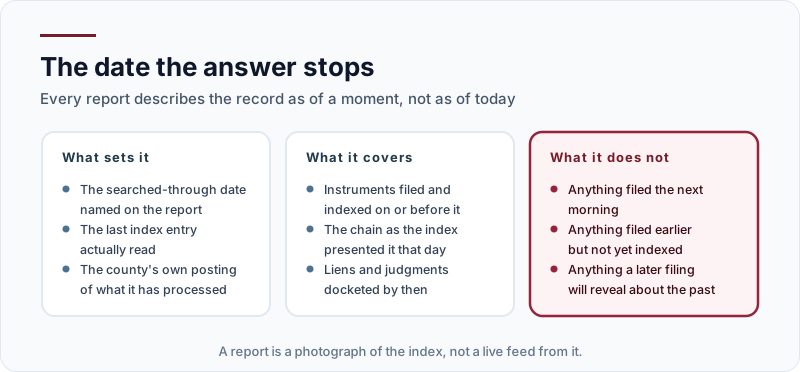
The effective date is set by the last entry the abstractor was actually able to read. That sounds circular until you see what it excludes. It covers instruments filed and indexed on or before that day, the chain exactly as the index presented it, and the judgments and liens docketed by then.
It says nothing about the next morning. It also says nothing about a deed filed three weeks ago that has not yet been keyed into the index, which is the part that surprises people, and the part worth understanding properly.
Filed today, findable later
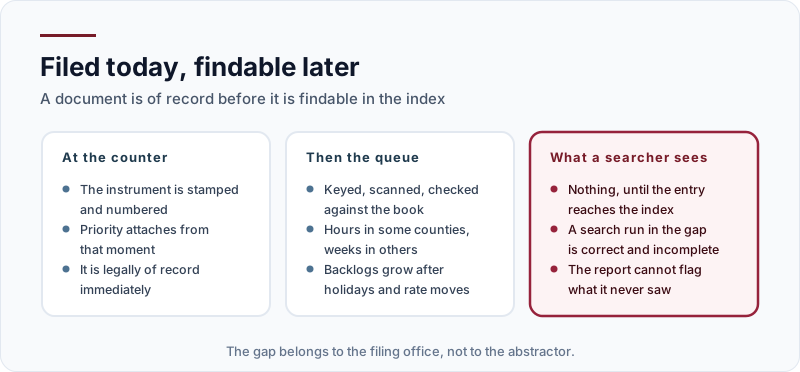
A document becomes part of the public record the moment it is accepted at the counter. It is stamped, numbered and, in most states, its priority attaches from that instant. None of that makes it findable. The sequence that turns a filed instrument into a searchable one is described in how a document becomes a public record, and the work between the two ends of it takes time.
How much time depends entirely on the office. Some counties post entries the same afternoon. Others run days or weeks behind, and every office runs further behind after a holiday, after a courthouse system migration, and after any rate move that sends a wave of refinances through the door at once. This is one more consequence of the fact that recording practice is local — there is no national standard for how quickly a filing has to become visible.
During that window the instrument exists in law and does not exist in the index. A search run in the window is performed correctly, reports accurately on everything it could see, and cannot mention what was sitting in a queue in a back office.
Why the gap is not a defect
It is tempting to read this as sloppiness somewhere. It is not. Filing has to be instantaneous, because priority depends on the minute a document arrives. Indexing has to involve human verification, because an entry keyed to the wrong name is worse than no entry at all. Those two requirements cannot both be satisfied instantly, and every recording system in the country resolves the tension the same way.
So the gap is a structural feature of how land records work. What varies is its size, and its size is something you can find out.
What to do about it
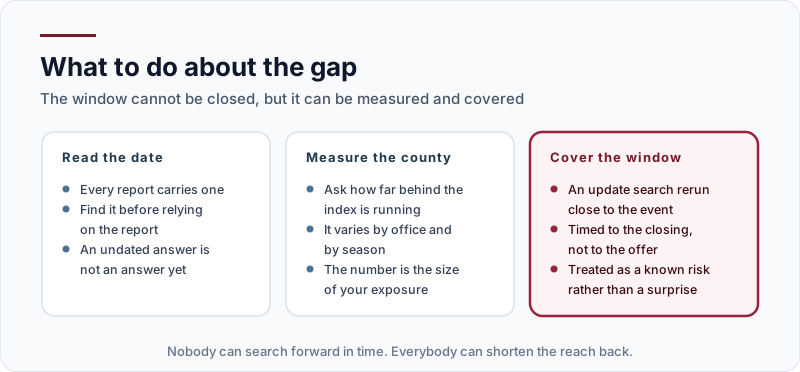
Three habits cover most of the exposure. Read the effective date before you rely on a report — an undated answer is not yet an answer. Ask how far behind the index in that county is currently running, because that number is the size of your blind spot. Then time the last look to the event rather than to the offer, so the window you are exposed to is as short as you can make it.
An older report is not wrong. It answers a question about an earlier date, and whether that is still the question you have is a judgment about how much can have happened since.
The takeaway
A search is a photograph of an index, not a live feed from it. The effective date tells you when the shutter closed, and the indexing lag tells you how far the picture already trailed reality when it did. Neither can be eliminated, and both can be measured. Find the property that runs your search, or tell us what you are trying to establish and when it has to be true and we will tell you how the timing should be set before anything is ordered.