

· AFX Research, LLC
How Long a County Keeps a Record, and What Eventually Gets Purged
Retention schedules, the series that survive permanently, the ones that do not, and why a file that cannot be produced today was usually disposed of lawfully.
Table of Contents
People assume that a public record, once made, is permanent. Most are not. Every office that creates records operates under a retention schedule, and that schedule says how long each kind of file is kept before it may be destroyed. Understanding which category a document fell into explains most of the moments when a search comes back empty, and it is a different situation from the one in our note on what happens when the records were destroyed, where a fire or a flood did the deciding.
What a retention schedule is
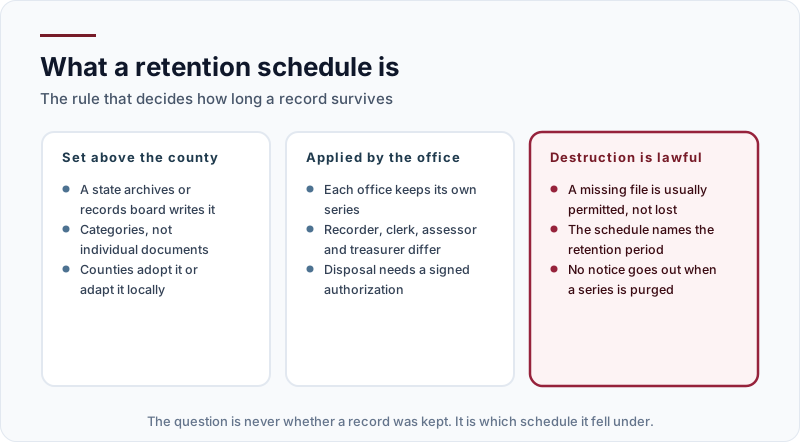
The schedule is written above the county. A state archives division or a records board publishes it, usually by category rather than by document, and counties adopt it or adapt it to local practice.
Each office then applies it to its own series. The recorder, the clerk of court, the assessor and the treasurer all hold different records under different rules, and disposal generally requires a signed authorization naming the series and the date range.
The important consequence is that destruction is lawful. A file that no longer exists was usually destroyed on purpose, on schedule, with paperwork. Nobody is notified, and nothing in the index announces it.
What is kept permanently
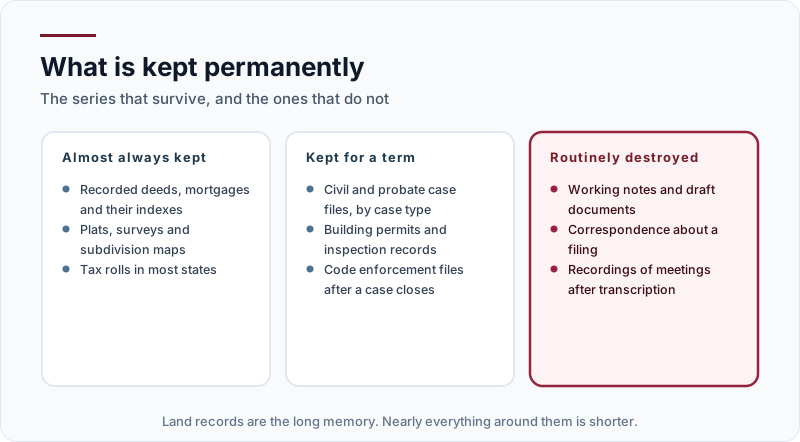
Land records are the long memory. Recorded deeds, mortgages and their indexes, plats and surveys, and in most states the tax rolls are retained permanently, which is why a chain of title can run two centuries while almost nothing around it does.
Court files are kept for a term that varies by case type, and building permits, inspection records and closed code enforcement files are frequently shorter still. Working notes, correspondence about a filing, and meeting recordings after transcription are routinely destroyed, and were never meant to last.
That asymmetry matters because the recorded instrument often outlives the proceeding that produced it. A judgment lien can sit in the land records long after the civil file behind it has gone.
Why land records are the exception
It is worth asking why deeds get permanent retention when almost nothing else does. The answer is that the land record is not really an archive, it is a working notice system, and it only works if it is complete backwards. A buyer today relies on being able to read every instrument affecting the parcel back to a root, and a gap anywhere in that run weakens every title downstream of it. Destroy twenty years of deeds and you have not lost twenty years of history, you have clouded every parcel in the county.
Nothing else carries that structural weight. A building permit from 1974 is useful if you have it and survivable if you do not, because no later owner’s title depends on reading it. That difference, rather than any judgment about importance, is what decides which schedules are permanent. The point is set out further in our note on what an index is.
What a purge looks like
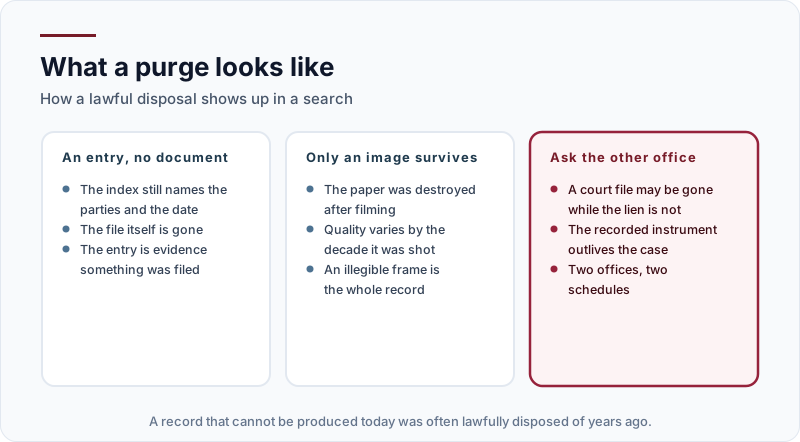
Usually as an index entry with nothing behind it. The index still names the parties and the date, the file itself is gone, and the entry remains evidence that something was filed even though its contents cannot be read.
Sometimes only a microfilm image survives, because the paper was destroyed after filming. Quality depends heavily on the decade the roll was shot, and an illegible frame is then the whole of the record.
And sometimes the answer is in a different office. A court file may be gone while the recorded lien is not, because two offices ran two schedules. Asking the other one is often the difference between a gap and an answer.
Recording and retention practice is local, so none of this should be read as a national rule. A search reports what was found of record on the day it was run.
The takeaway
When a document cannot be produced, the useful question is which office held it and under what schedule, not whether somebody lost it. The answer frequently points at a second office that still has what you need, which is part of why recording practice stays local, as our note on why recording practice is local sets out. Find the property that runs your search, or tell us what you are trying to establish and we will point you at the right one before anything is ordered.