

· AFX Research, LLC
What a Marginal Notation in an Old Record Book Can Mean
Handwriting in the margin of a deed or mortgage book, why clerks put releases and cross references there, and why that note is the one a digital index tends to lose.
Table of Contents
Open a mortgage book from 1931 and you will find writing in the margin beside the entries. A date, a few words, somebody’s initials. It looks like annotation, the sort of thing a clerk scribbled for their own convenience. It is usually nothing of the kind. In many states that handwriting is the legally authorized record of a release, and the mortgage beside it was discharged by exactly those words. Miss it and an old lien looks open when it has been satisfied for ninety years.
What the note is doing there
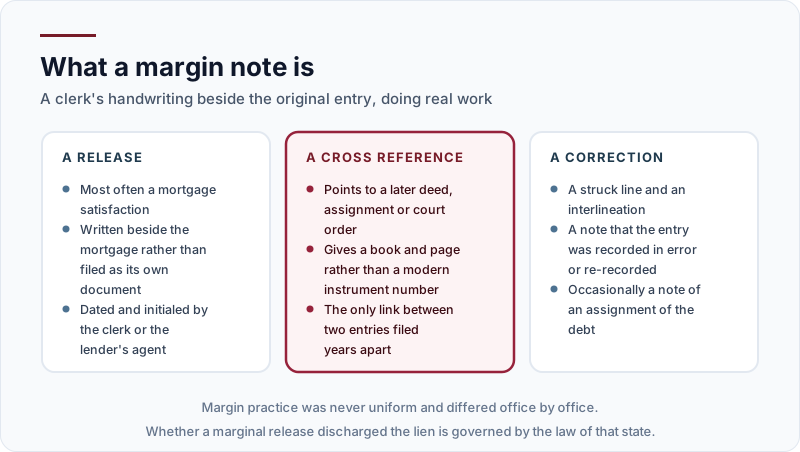
Most marginal notations fall into three groups. The first and most common is a release, nearly always a mortgage satisfaction, dated and initialed beside the mortgage rather than filed as its own document. The second is a cross reference, pointing to a later deed, assignment, or court order by book and page rather than by any modern instrument number, and frequently it is the only link between two entries filed decades apart. The third is a correction, a struck line, an interlineation, or a note that an entry was recorded in error or re-recorded elsewhere.
Margin practice was never uniform. It differed between offices in the same state and between decades in the same office. Whether a marginal release actually discharged the lien is governed by the law of that state, and that is a legal question rather than a records question.
Why the margin, rather than a separate filing
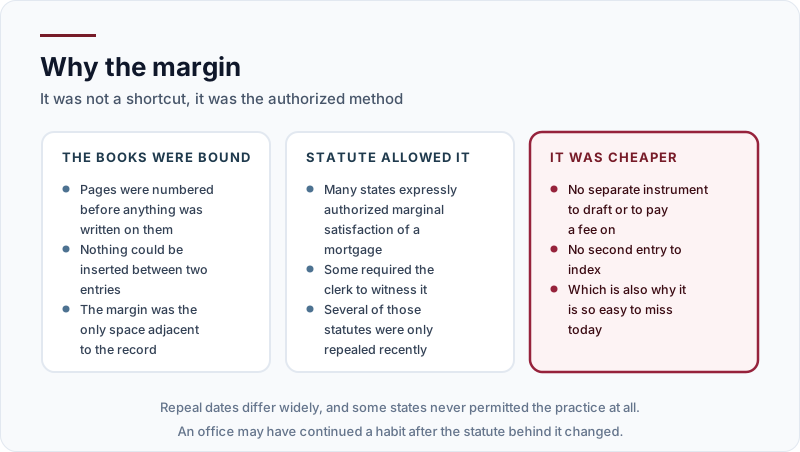
The practical reason is that the books were bound and paginated before anything was written in them. Nothing could be inserted between two entries, so the margin was the only space physically adjacent to the record it referred to.
The legal reason is that many states expressly authorized marginal satisfaction of a mortgage, some requiring the clerk to witness it. Several of those statutes survived into living memory before being repealed, and repeal dates differ widely. A few states never permitted the practice at all. It was also simply cheaper, with no separate instrument to draft, no fee to pay, and no second entry to index, which is precisely why it is so easy to overlook now.
The reason a modern search can miss it
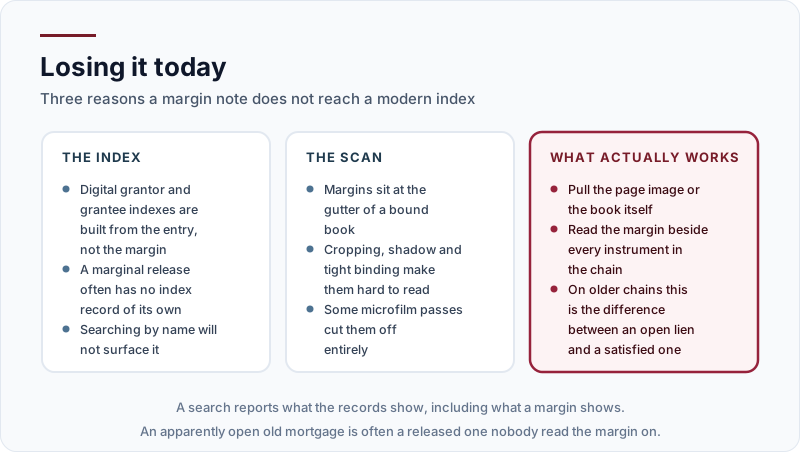
Digital grantor and grantee indexes are built from the recorded entry, not from the margin beside it. A marginal release usually has no index record of its own, so no amount of name searching will surface it. Then there is the scan. Margins sit at the gutter of a bound volume, where tight binding, shadow, and cropping make them hard to read, and some microfilm passes cut them off entirely.
What works is unglamorous. Pull the page image or, where it exists, the book, and read the margin beside every instrument in the chain. On a chain that runs back before the 1950s, that single habit is frequently the difference between reporting an open lien and reporting a satisfied one. It is the same problem handwritten and archaic records pose generally, and part of why the index decides the answer rather than the documents alone.
What this means when you order a search
Ask whether the term searched reaches back far enough to hit margin-era books, and whether the searcher is reading page images rather than index entries alone. A report of an unreleased 1940s mortgage deserves a second look at the original page before anyone treats it as a live encumbrance, and a researcher working in the office can read the book directly. That local presence is most of what the network is for.
The takeaway
Handwriting in a margin is a record, not a note. It carries releases, assignments, and cross references that no digital index inherited, it is invisible to a name search, and on an older chain it is routinely the item that explains why a long-dead lien is not actually a problem.
Find the property that runs your search, or tell us what you are trying to establish and we will point you at the right one before anything is ordered.