

· AFX Research, LLC
What a Registered Land System Changes About a Title Search
How a certificate of title differs from a chain of recorded documents, which interests sit outside the certificate, and why a parcel can belong to both systems over time.
Table of Contents
Almost everywhere in the country, a title search means assembling a chain out of separately filed documents. In a handful of states, some parcels work the other way round. A court decided the title once, a registrar keeps a certificate for the parcel, and every interest that touches it is written onto that certificate. The search is still a search, but almost nothing about the mechanics is the same.
Two ways to hold the record
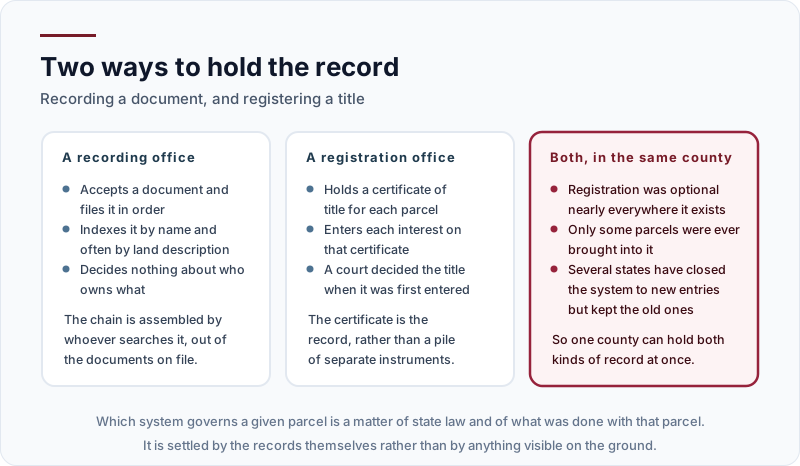
A recording office accepts a document, files it in order, and indexes it under names and often under a land description. It decides nothing about ownership, which is why the chain has to be assembled by whoever searches it. That is the arrangement described in our note on what an index is and why it decides the answer.
A registration office keeps a certificate of title for each registered parcel and enters each interest on it. The certificate is the record rather than the raw material for one. The difference is not just filing technique. Behind the first certificate there was a court proceeding in which everyone with a possible claim was given notice and the claims were resolved, and the certificate issued at the end of it is meant to carry that resolution forward. A recording system never resolves anything; it only preserves what people chose to file.
The important fact for anyone ordering a search is that both can exist in the same county. Registration was optional nearly everywhere it was offered, only a fraction of parcels were ever brought in, and several states have since closed the system to new entries while keeping the registrations already made.
What a certificate carries
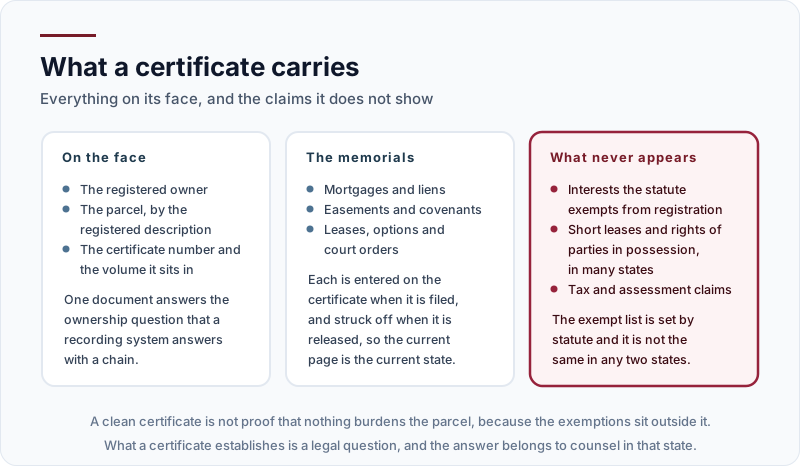
On the face sit the registered owner, the parcel as registered, and the certificate number. One page answers in a sentence what a recording system answers with a chain.
Below that come the memorials. Mortgages, liens, easements, covenants, leases, options and court orders are entered when filed and struck off when released, so the current certificate is meant to be the current state of the title.
What never appears is the part worth knowing about. Statutes exempt certain interests from registration, and in many states those include short leases, rights of parties in possession, and some tax and assessment claims. The exempt list is set by statute and no two states draw it the same way, which means a clean certificate is not proof that nothing burdens the parcel. That limit is the same one our note on what it means when a search finds nothing sets out in the ordinary case.
How the search work differs
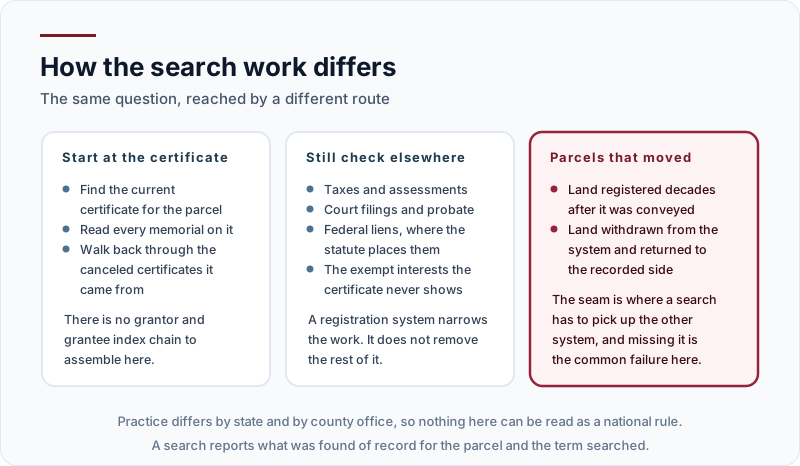
The work starts at the certificate rather than in the index. Find the current one, read every memorial, and walk back through the canceled certificates it came from. There is no grantor and grantee chain to build.
Plenty still has to be checked elsewhere. Taxes and assessments, court filings and probate, federal liens where the statute places them, and the exempt interests the certificate was never going to show. A registration system narrows the work, and does not remove it. It also does not make the work faster in every case, because the older canceled certificates are frequently in volumes that are not online, and reading them is counter work like any other.
The real trap is a parcel that moved. Land registered decades after it was first conveyed, or withdrawn from the system and returned to the recorded side, leaves a seam, and a search that does not pick up the other system at that point has stopped early. Spotting it is part of why recording practice is local rather than something that can be assumed from a distance.
The takeaway
Which system governs a parcel is a matter of state law and of what was actually done with that parcel, and it is settled by the records rather than by anything visible on the ground. A search reports what was found of record for the parcel and the term searched. Find the property that runs your search, or tell us what you are trying to establish and we will point you at the right one before anything is ordered.