

· AFX Research, LLC
What a Search Does With a Record Written in Another Language
Where Spanish, French and German land records still sit in American counties, what the office actually holds, and how a search finds and reports one.
Table of Contents
The public record is older than the county around it. Run a chain far enough back in the right place and you reach a document written by someone who was not writing in English, filed under a government that no longer exists, in a hand that takes a while to settle into. It is a less exotic problem than it sounds, and it is a close relative of reading handwritten and archaic records.
Where it comes up
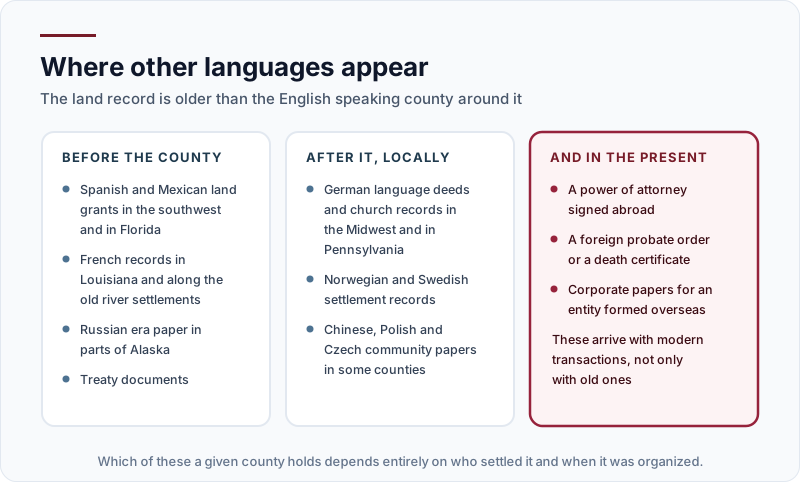
Before the county existed. Spanish and Mexican land grants across the southwest and in Florida, French records through Louisiana and the old river settlements, Russian era paper in parts of Alaska, and treaty documents wherever land passed from one sovereign to another. In several states the root of a chain is a grant made under a legal system the current one inherited rather than replaced.
After it, from the people who settled it. German language deeds and church records across the Midwest and in Pennsylvania, Norwegian and Swedish settlement papers, and in particular counties Chinese, Polish or Czech community records.
And in the present. A power of attorney signed abroad, a foreign probate order, a death certificate, corporate papers for an entity formed overseas. These arrive with ordinary modern transactions, which is why this is not only a question about old land.
What the office actually holds
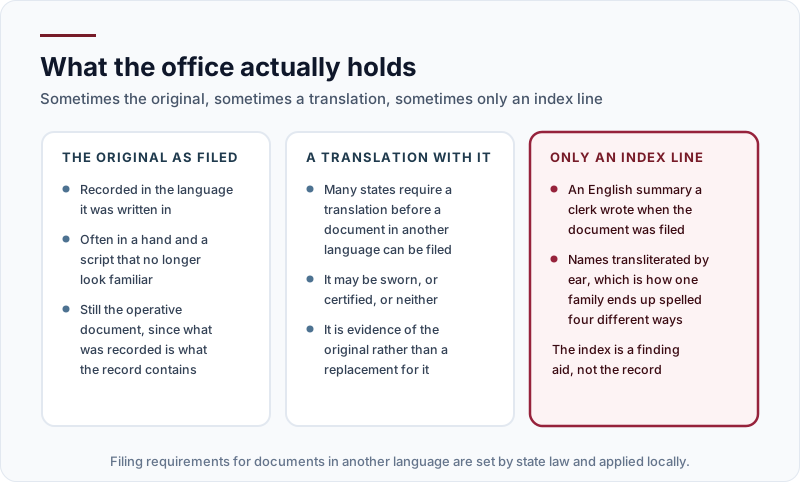
Sometimes the original, recorded in the language it was written in, because what was recorded is what the record contains. Sometimes a translation filed alongside it, since many states require one before a document in another language can be accepted, though whether it must be sworn or certified varies. A translation is evidence of the original rather than a replacement for it.
And sometimes the only searchable trace is an index line, an English summary a clerk wrote at the counter when the document came in. That is where the names get transliterated by ear, and it is how one family ends up spelled four different ways across fifty years of filings. The index is a finding aid, not the record.
How the search handles it
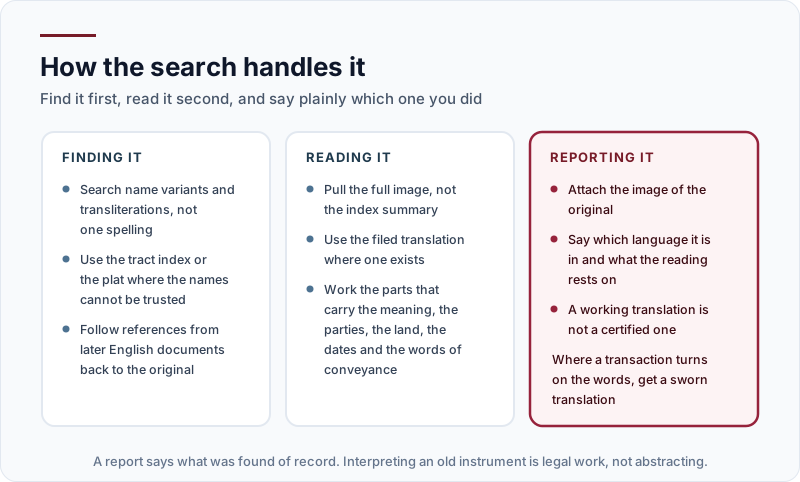
Finding it comes first, and names are the weak point. The search runs variants and transliterations rather than one spelling, leans on the tract index or the plat where the names cannot be trusted at all, and follows references in later English documents back to the instrument they cite. A deed from 1908 that recites “the grant to Vigil” is often the thread that leads to the grant itself.
Reading it comes second. Pull the full image rather than the summary, use the filed translation where one exists, and work the parts that carry the meaning, which are the parties, the land, the dates and the words of conveyance. The flourishes matter less than people expect.
Reporting it honestly comes third. Attach the image of the original, say which language it is in, and say what the reading rests on. A working translation is not a certified one. Where a transaction turns on exactly what the words say, that calls for a sworn translation, and interpreting what an old instrument accomplished is legal work rather than abstracting. This is the same line that separates a search report from an opinion.
What to expect if your chain runs through one
Expect it to take longer, because the image has to be pulled and read rather than scanned from an index line. Expect the name spellings in the report to look inconsistent, because they were inconsistent in the record. And expect the report to tell you where the certainty stops, since that is more useful than a confident paraphrase of a document nobody translated properly. Which languages a given county holds depends entirely on who settled it and when it was organized, which is one more instance of why recording practice is local.
The takeaway
A record in another language is still a record, and it is still findable, but it moves the work from the index to the image. Find the property that runs your search, or tell us what you are trying to establish and we will point you at the right one before anything is ordered.