

· AFX Research, LLC
What a Title Plant Is, and How It Differs From the Record
What a title plant holds, how it is built and kept current, the lag between recording and posting, and the three gaps that send the work back to the courthouse.
Table of Contents
If you have ever been told a search came back “from the plant,” you were told something about the method rather than about the source. A title plant is a private index of the public record, built and maintained by a company, arranged the way an examiner wants to read it rather than the way the county filed it. It is a genuinely useful thing and it is routinely mistaken for the record itself, which is a different and much more consequential thing.
What a plant holds
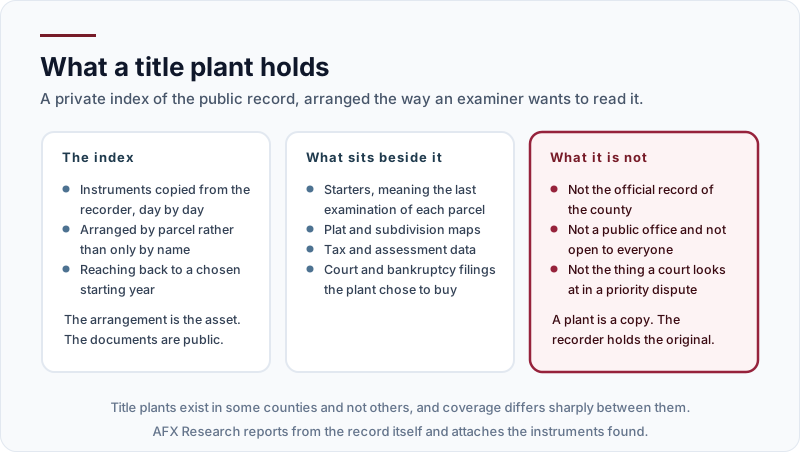
The core of a plant is an index of instruments copied from the recorder day by day and arranged by parcel. That arrangement is the asset. Many county indexes are organized by name, and what an index is and why it decides the answer explains why that choice shapes everything downstream. A plant that keys the same documents to a parcel lets an examiner ask a question the county index was never built to answer directly.
Around the index sit starters, which are prior examinations of the same parcel, plus plat maps, assessment data, and whatever court filings that plant decided to buy.
What it is not is the official record. It is not a public office, it is not open to everyone, and it is not what a court consults when two people claim the same land. The recorder holds the original, and the copy is only ever as good as the copying.
How one is built
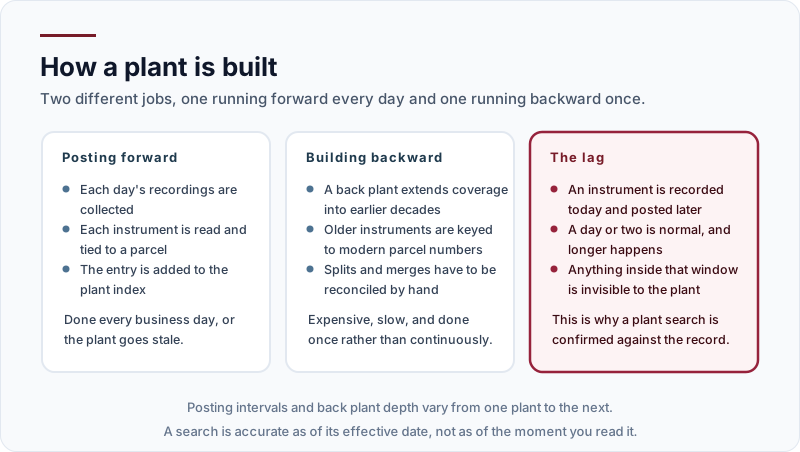
Two jobs run in parallel. Posting forward means collecting each day’s recordings, reading each instrument, tying it to a parcel and adding the entry. Skip a few days and the plant is stale.
Building backward is the other job, and it is the expensive one. A back plant extends coverage into earlier decades, which means keying old instruments to modern parcel numbers and reconciling every split and merge that happened in between. It is done once, by hand, and the depth a plant reaches is a business decision rather than a standard.
Then there is the lag. An instrument recorded this morning is posted to the plant later — a day or two is normal and longer happens — and anything inside that window is invisible. That is one of the reasons every search carries an effective date rather than a promise about today.
Where it stops
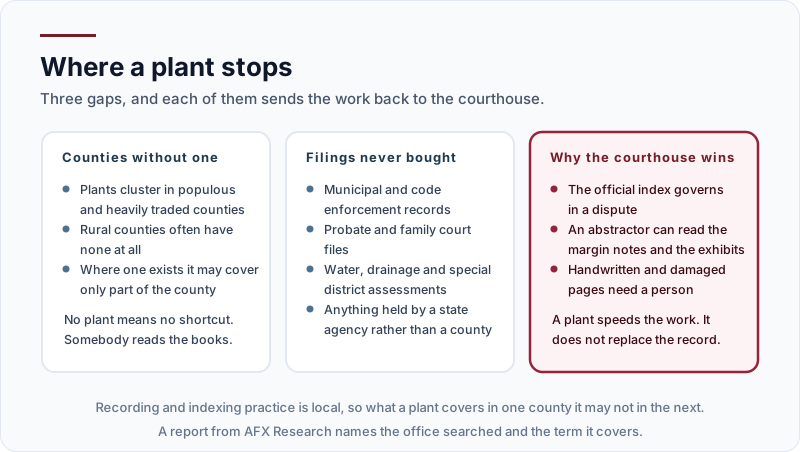
Three gaps matter. Plants cluster where property trades heavily, so a great many counties have none, and where one exists it sometimes covers only part of the county. Second, a plant holds what it chose to buy, which commonly leaves out municipal and code enforcement records, probate and family court files, special district assessments and anything a state agency holds rather than a county. Third, the official index governs in a dispute, and reading margin notes, exhibits and handwritten pages is work for a person.
This is also why the same property can produce two different answers from two searches. One read a plant and one read the books, and they were not looking at the same thing.
Why any of this matters to you
Mostly it matters when the answers disagree. If you have ordered work on the same property from two providers and received different results, the method is the first place to look, well before anybody assumes somebody made a mistake. A plant search and a courthouse search can both be competent and still return different sets of instruments, because they started from different indexes with different depths and different cut-off dates.
It also matters when the property is unusual. A parcel created by a split last year, land that has sat in one family since before the plant’s starting date, or ground that straddles a boundary are all cases where an index keyed to today’s parcel numbers has the most trouble. What a search finds on land that never changed hands is the extreme version of that problem.
The practical question to ask a provider is not which tool they used. It is which office they searched, how far back, and as of what date. Those three facts are what make a report checkable, and a report that will not give them is worth less whatever it was built from.
The takeaway
A plant is a tool, not a source. Where one exists it makes the work faster, and where it does not somebody still walks into the courthouse and reads the index. Neither approach changes what the county actually holds, and both should tell you which office was searched and over what term. Find the property that runs your search, or tell us what you are trying to establish and we will point you at the right one before anything is ordered.