

· AFX Research, LLC
What the Words Grantor and Grantee Mean in a Records Index
Why every recorded document has both a grantor and a grantee, how the labels reverse across the life of a loan, and what a name index can never settle.
Table of Contents
Two words decide how almost every land record in the country is filed and found. They sound like they describe ownership, and they do not. Once you see what they actually describe, a great deal about what an index is and why it decides the answer falls into place.
The plain case
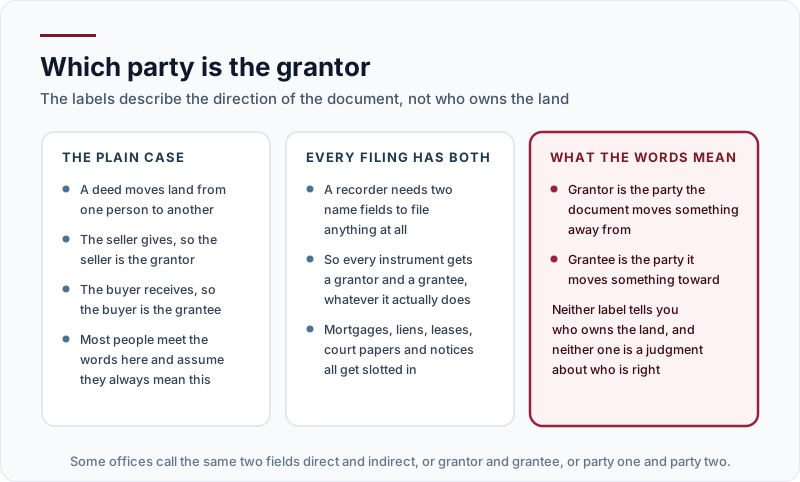
A deed moves land from one person to another. The seller gives, so the seller is the grantor. The buyer receives, so the buyer is the grantee. Most people meet the words here, on a closing statement, and reasonably conclude that grantor means seller and grantee means buyer.
Then the same two words show up on a mortgage, a tax lien, a court order and a notice of a lawsuit, and the mapping stops working. The reason is structural. A recorder needs two name fields to file anything at all, so every instrument that comes through the door gets a grantor and a grantee whether or not anything is being sold.
What the words really mean is direction. The grantor is the party the document moves something away from. The grantee is the party it moves something toward. Neither label says who owns the property, and neither is a finding that anybody is right.
Watch them reverse
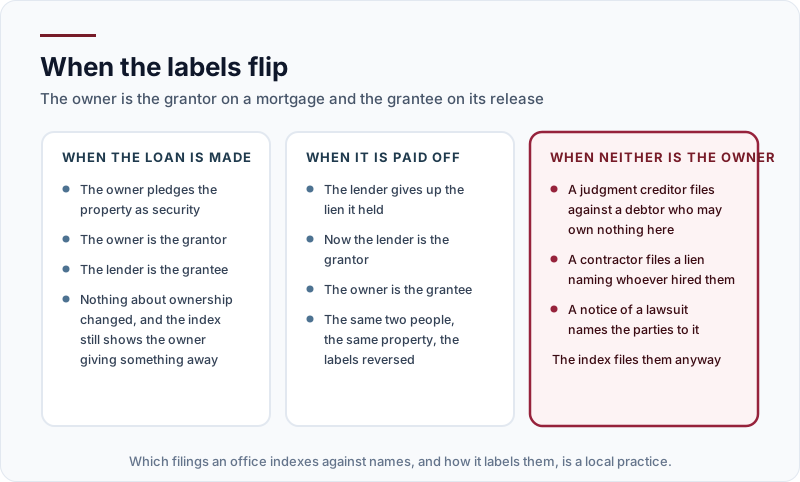
Follow one loan through. When it is made, the owner pledges the property as security, so the owner is the grantor and the lender is the grantee. Nothing about ownership has changed. Years later the loan is paid and the lender gives up the lien it held, so now the lender is the grantor and the owner is the grantee. Same two parties, same property, labels reversed.
Then there are the filings where neither named party owns anything. A judgment creditor files against a debtor who may own nothing in that county. A contractor files a lien naming whoever hired them, who might be a tenant. A notice of a pending suit names the parties to the suit. The index files all of it, because filing is what the office does, and sorting out whether it attaches to this land is a later question.
How a search uses the two lists
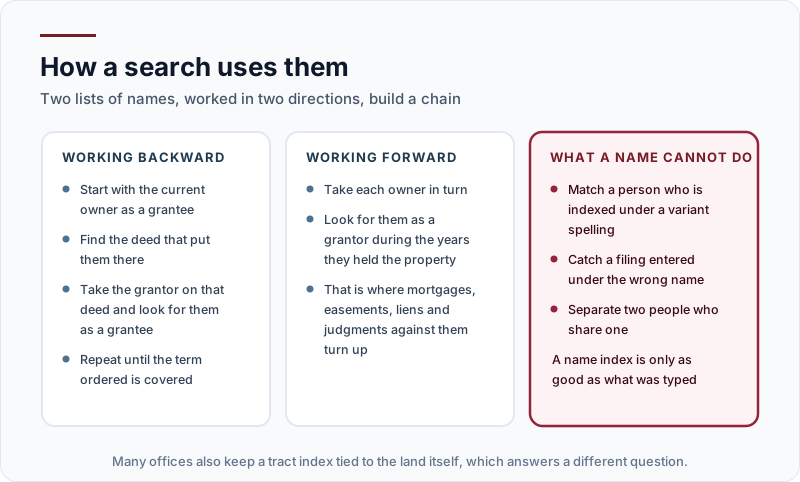
Backward, to build the chain. Start with the current owner as a grantee and find the deed that put them there. Take the grantor on that deed and look for that name as a grantee. Repeat until the term being searched is covered. That is the chain of title, assembled one hop at a time.
Forward, to find the burdens. Take each owner in turn and look for that name as a grantor during the years they held the property. Mortgages, easements, liens and judgments against that owner show up here, because each of them moved something away.
What a name index cannot do is match a person it never recorded correctly. A variant spelling, a filing entered under the wrong name, two people who share one name. Those limits are the reason name searches and parcel searches answer different questions, and the reason many offices keep a tract index tied to the land itself alongside the name lists.
Why any of this matters to you
If you are reading a report, the labels tell you what each document did and which direction it ran, which is most of what you need to make sense of a list of filings. If you are ordering a search, it explains why we ask for every name a party has used, including maiden names, former entity names and the way a name was spelled on the deed rather than the way it is spelled now. A missed variant is a missed document, and the index has no way to know they were the same person, which is the whole difficulty behind a very common name.
The takeaway
Grantor and grantee describe the direction a document runs, not who holds title. The same person can be either one, sometimes on two filings a week apart, and the index will file both without comment. Find the property that runs your search, or tell us what you are trying to establish and we will point you at the right one before anything is ordered.