

· AFX Research, LLC
How a Search Handles a Very Common Name in the County Index
Why a land index built on names struggles with the common ones, what actually narrows the field, and how a report should describe a match it cannot confirm.
Table of Contents
A land index is a list of names. That is its strength and it is the whole of its weakness, because names are not unique and the record has no way of telling two people apart beyond what somebody typed onto a document decades ago. Search a county for a name shared by four hundred people and the index will hand back every one of them without comment. The underlying design is the subject of our note on what an index is and why it decides the answer. What follows is what happens when the name itself is the problem.
Why a common name is hard
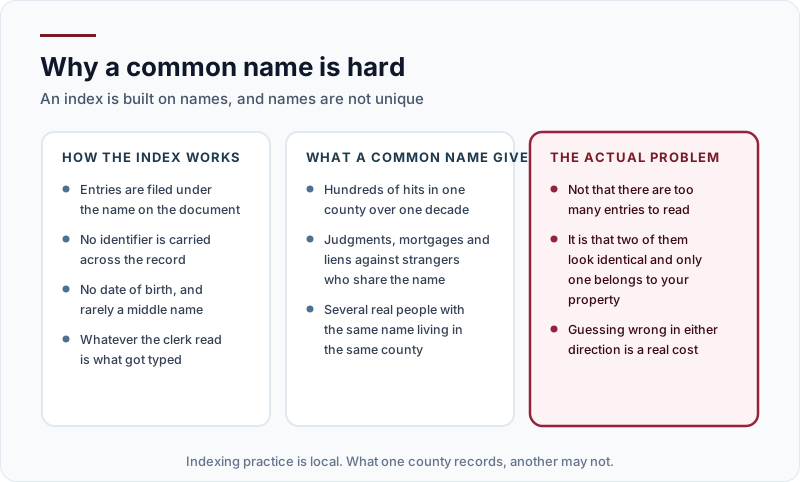
Entries are filed under the name that appears on the document. There is no identifier carried across the record, no date of birth, rarely a middle name, and whatever the clerk read is what got typed. A county index is not a database about people. It is a list of filings organized so that a filing can be found again.
So a common name produces hundreds of hits in one county over one decade. Judgments, mortgages and liens belonging to strangers who happen to share it. Several real people of the same name living in the same place, sometimes related to each other, sometimes not.
The volume is not actually the problem. Reading a hundred entries is tedious but finite. The problem is that two of those entries look identical and only one of them belongs to the property you asked about, and guessing wrong in either direction has a cost. Report a stranger’s judgment and you have manufactured a title defect. Omit the real one and you have missed a lien.
What narrows the field
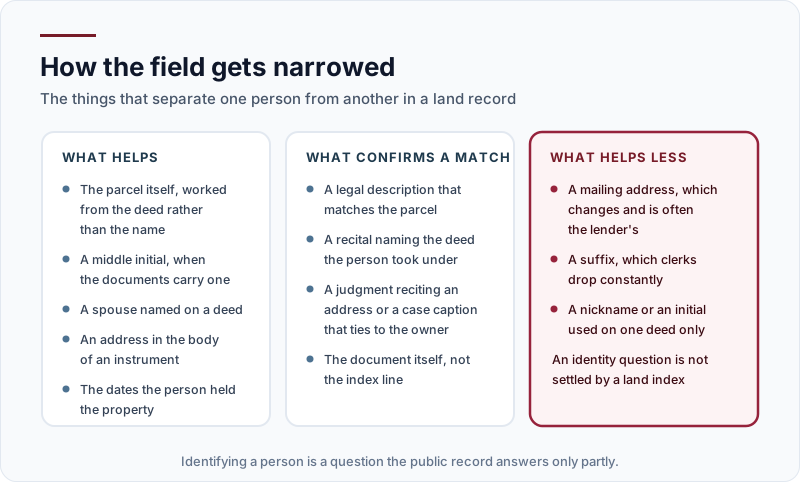
The parcel helps most. Working from the deed forward rather than from the name outward anchors the search to a piece of ground, and the ground does not have a namesake. A middle initial helps where the documents carry one. So does a spouse named on a deed, an address recited in the body of an instrument, and the dates the person actually held the property, because a judgment recorded eight years after they sold is a different conversation.
Confirmation comes from documents rather than index lines. A legal description that matches. A recital naming the deed the person took under. A judgment that recites an address or carries a case caption tying back to the owner. This is one of the reasons our note on why a recorded document is not searchable the same day matters here, since the index entry and the image arrive at different times.
What helps less than people expect is a mailing address, which changes and is frequently the lender’s rather than the owner’s, and a suffix, which clerks drop constantly. An identity question is not settled by a land index.
What a match actually proves
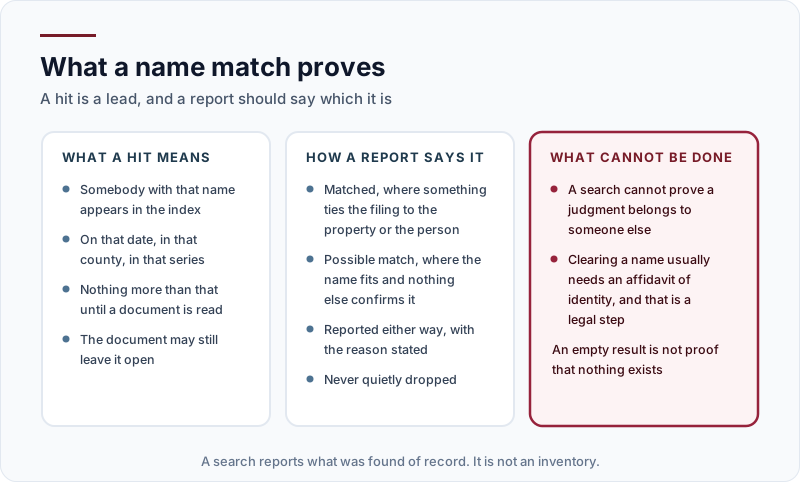
A hit means somebody with that name appears in that index, on that date, in that series. Nothing more, until a document has been read, and sometimes not much more afterward.
A report should say which it is. Matched, where something ties the filing to the property or the person. Possible match, where the name fits and nothing else confirms it. Both get reported, with the reason stated, and neither gets quietly dropped. That is the honest version, and it is what our note on how a search is checked before it goes out is built around.
What a search cannot do is prove a judgment belongs to someone else. Clearing a name normally takes an affidavit of identity or a similar step, and that is a legal matter rather than a research one. Recording and indexing practice varies by county, a search reports what was found of record, and an empty result is not proof that nothing exists.
The takeaway
If the owner’s name is a common one, say so up front and send whatever you have that is not a name. A parcel number, a middle initial, a spouse, the dates of ownership. Each of those turns a long list into a short one. Find the property that runs your search, or tell us what you are trying to establish and we will point you at the right one before anything is ordered.