

· AFX Research, LLC
When Personal Property Becomes Real Property in the Record
Why a manufactured home or a piece of fixed equipment can sit in two record systems at once, what the conversion paperwork does, and which search reaches which office.
Table of Contents
Some things are obviously land and some things are obviously not. The interesting cases are the ones that started as goods and ended up fixed to a parcel, because the public record was never designed to handle an object that changes category. A manufactured home is the common example. Heavy equipment bolted into a plant is another, and so is a solar array on a commercial roof.
Two kinds of property, two kinds of record
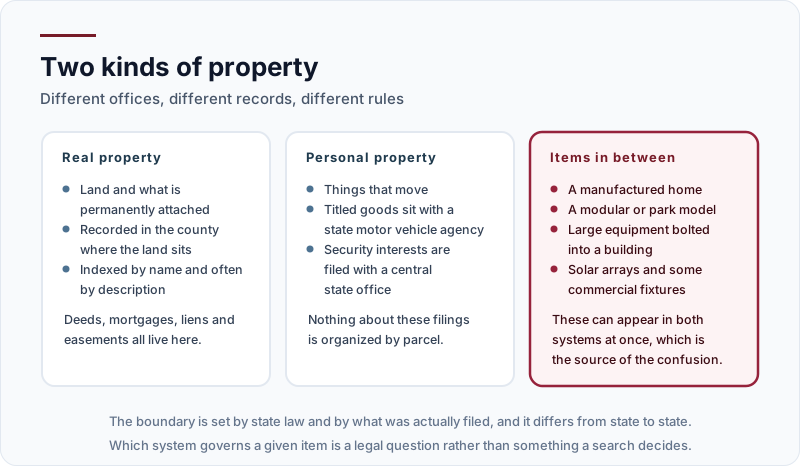
Real property is land and what is permanently attached to it, recorded in the county where the land sits and indexed by name and often by description. Deeds, mortgages, liens and easements all live there, and the organizing idea is the parcel.
Personal property is organized around the thing or the owner instead. Titled goods sit with a state motor vehicle agency, and security interests in most other goods are filed with a central state office. Neither of those is searched by address, and neither is indexed by parcel, which is why they are invisible to a land records search no matter how thorough it is. That is a specific case of the point our note on what the recorder does not hold makes generally.
In between sit the items that cause trouble. A manufactured home, a modular or park model unit, large equipment fastened into a building, a commercial solar installation. Each of these can appear in both systems at the same time, and the question of which one governs is rarely answered by looking at the object. It is answered by looking at what was filed, which is a different exercise and frequently a longer one.
How a thing becomes land
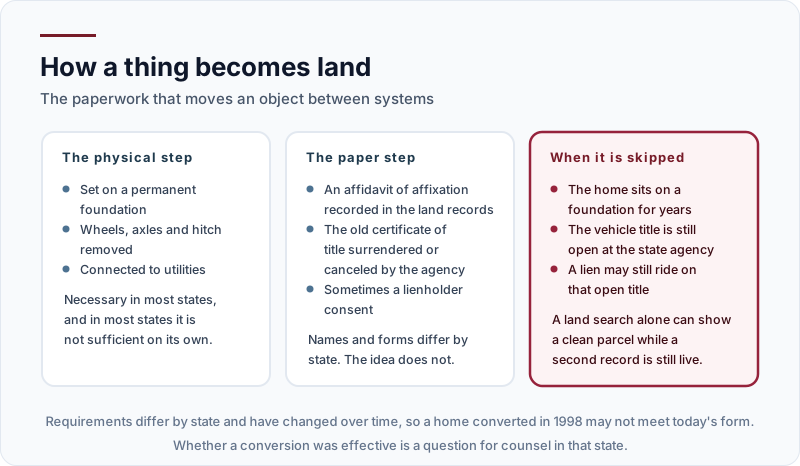
The physical step is the familiar one. The home is set on a permanent foundation, the wheels, axles and hitch come off, the utilities are connected. In most states that is necessary and in most states it is not enough on its own.
The paper step is what finishes the job. Typically an affidavit of affixation is recorded in the land records, the old certificate of title is surrendered or canceled by the state agency, and in some states a lienholder has to consent. The names and the forms differ from one state to the next, and they have been rewritten in many states over the last twenty years.
The step gets skipped more often than you would expect. A home sits on a foundation for a decade while the vehicle title stays open at the agency, sometimes with a lien still riding on it. A land search alone can report a perfectly clean parcel while that second record is very much alive, which is a version of the problem described in when the record and the ground disagree.
Which search answers it
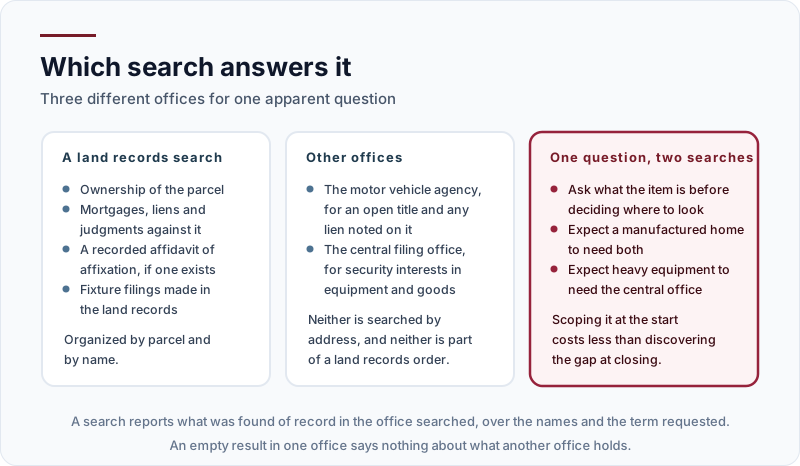
A land records search returns ownership of the parcel, the mortgages, liens and judgments against it, a recorded affidavit of affixation if one exists, and the fixture filings made in the land records. All of it organized by parcel and by name. What a search of that kind does with an unusual item is report the filings it finds and describe where they were found, which is the discipline set out in what a certified abstractor actually does.
The other offices hold the rest. The motor vehicle agency for an open title and any lien noted on it, the central filing office for security interests in equipment and goods. Neither is part of a land records order, and asking for both at the start costs less than finding the gap at a closing. Saying what the item is before deciding where to look is most of the work, and it is the same scoping conversation our note on what a search needs from you describes.
The takeaway
The boundary between the two is set by state law and by what was actually filed, and it differs from state to state, so whether a particular conversion was effective is a question for counsel rather than a finding in a search. An empty result in one office says nothing about what another office holds. Find the property that runs your search, or tell us what you are trying to establish and we will point you at the right one before anything is ordered.