

· AFX Research, LLC
Why a Recorded Document Is Not Searchable on the Same Day
The steps between the recording counter and the index entry, what makes the delay longer in one office than another, and how a report accounts for the gap.
Table of Contents
A deed recorded on Monday morning is of record on Monday morning. Whether anybody can find it on Monday morning is a separate question, and the answer is frequently no. Between the counter and the searchable index there is a pipeline of work, and the length of that pipeline is one of the quieter reasons two searches of the same property can come back differently. This is a different gap from the one described in our note on the gap between closing and recording, and it sits on the far side of it.
The path from counter to index
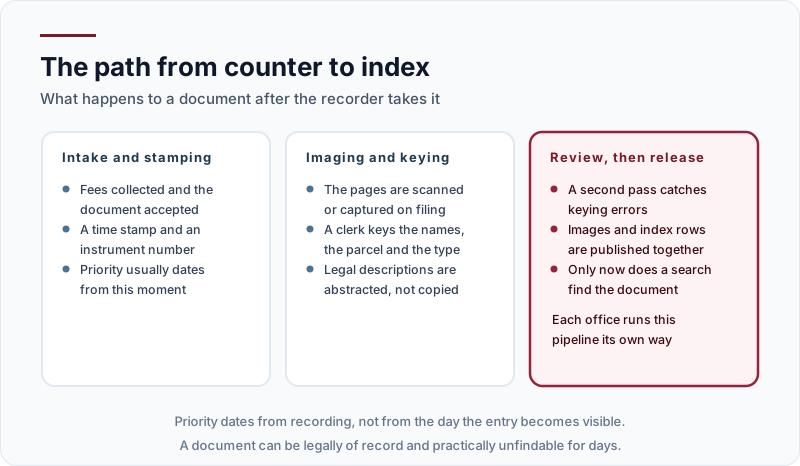
Intake comes first. Fees are collected, the document is checked for whatever the state requires on its face, and it is stamped with a time and an instrument number. In most states priority dates from that moment, which is why the stamp matters more than anything that follows.
Then the document has to be turned into data. The pages are imaged, and a clerk keys the names, the instrument type, the parcel reference and whatever else the office indexes. Legal descriptions are usually abstracted rather than transcribed, which is its own source of error.
Finally there is review. A second pass catches keying mistakes before the entry is published, and in most offices images and index rows go live together. Only at that point does a search find the document. Every office runs this pipeline its own way, which is the practical meaning of the point in our note on why recording practice is local.
What stretches the lag
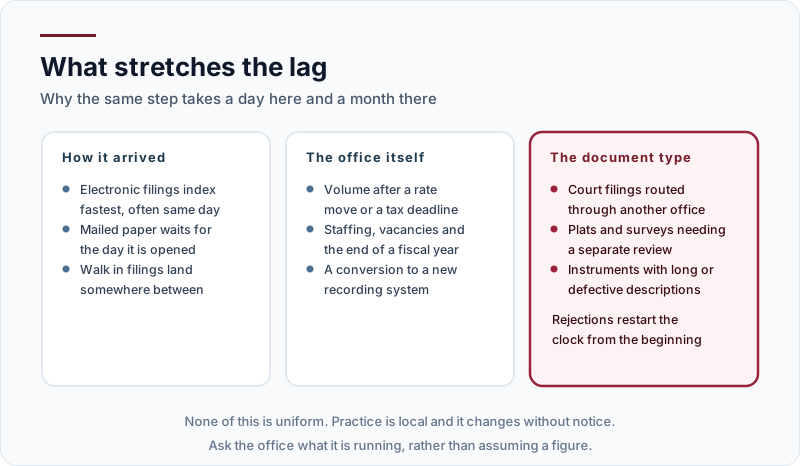
How the document arrived matters most. Electronic filings frequently index the same day, because the data came in with the image and much of the keying is already done. Mailed paper waits for the day somebody opens the envelope. Walk in filings land somewhere between the two.
The office itself is the second variable. Volume spikes after a rate move or ahead of a tax deadline, staffing varies, and a conversion to a new recording system can slow an office for weeks while everyone learns it.
Document type is the third. Court filings routed through another office arrive late by design, plats and surveys often need a separate review, and an instrument with a long or defective description takes longer to key. A rejection restarts the clock entirely, and the refiled document usually keeps its new date rather than the old one.
How a search accounts for it
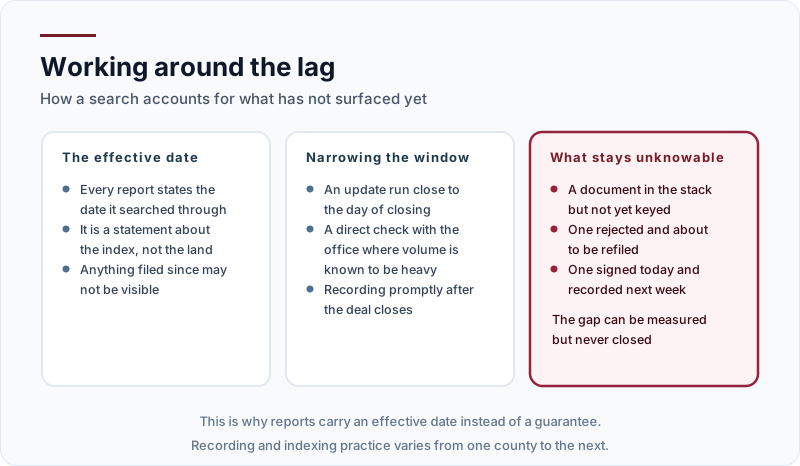
Every report carries an effective date, and that date is a statement about the index rather than about the land. It says what had surfaced by then. Anything filed since may be sitting in the stack, correctly recorded and genuinely unfindable.
The window can be narrowed. An update run close to the day of closing catches most of it, and in an office known to be running behind, a direct inquiry is worth more than another search. Recording your own documents promptly keeps you out of the same position on the other side.
What cannot be fixed is the residue. A document in the stack but not yet keyed, one rejected and about to be refiled, one signed today and recorded next week. The gap can be measured and planned around, which is what an effective date is for, but it does not close. That is also why a search says nothing about documents nobody has recorded, a point our note on what it means when a search finds nothing makes at more length.
The takeaway
Recorded and searchable are two different states, separated by work that happens at a different speed in every office. Read the effective date on any report as the real boundary of what it covers, and ask about the local lag when the timing is tight. Find the property that runs your search, or tell us what you are trying to establish and we will point you at the right one before anything is ordered.