

· AFX Research, LLC
What Happens Between Signing a Deed and Finding It in the Record
Signing, recording and indexing are three separate events with real time between them, and the interval is where a search can honestly miss something that already exists.
Table of Contents
People speak as though a deed enters the public record at the moment it is signed. It does not. Between the signature and the point where anyone searching can find the document there are several distinct steps, each of which takes time, and the amount of time is decided locally. That interval explains a good deal of what otherwise looks like inconsistency in search results.
Four steps, not one
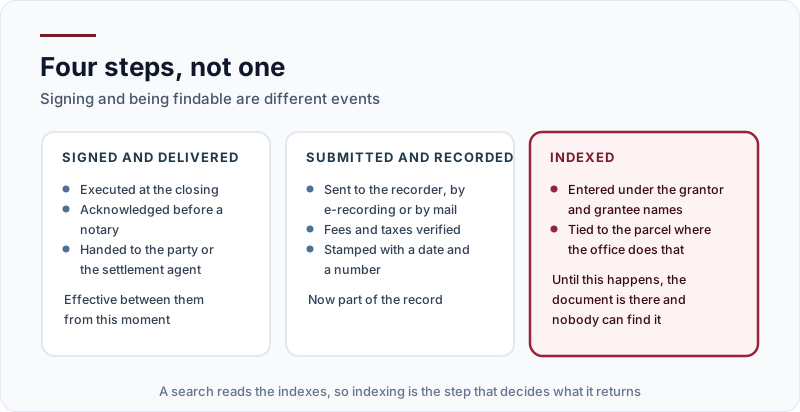
A deed is executed and acknowledged, then delivered. As between the two parties it is generally effective from that point, and nothing about the county’s records changes that.
It is then submitted to the recorder, where fees and transfer taxes are checked and the instrument is stamped with a date and a number. At that moment it is part of the record, and the sequence is set out in how a document becomes a public record.
The fourth step is the one that matters to a search. The document has to be indexed, meaning entered under the names of the parties and, where the office does it, tied to the parcel. A search reads indexes. Until the entry exists, the document sits in the record and nobody looking for it can find it, which is the argument made in what an index is and why it decides the answer.
How long the gap actually runs
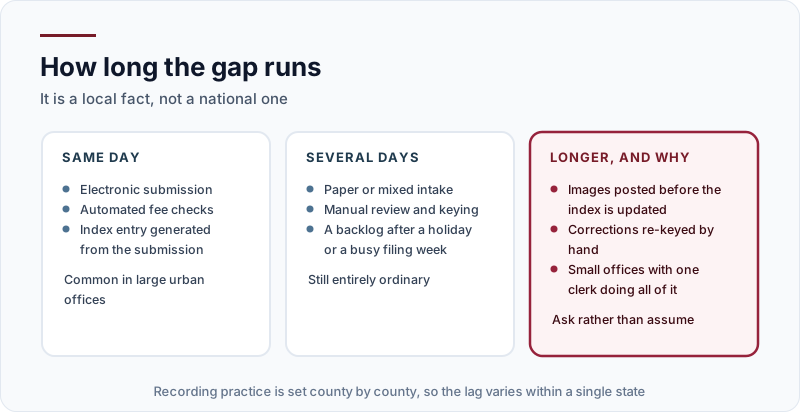
In a large office taking electronic submissions, a deed recorded in the morning can be indexed and searchable the same afternoon. In an office handling paper, with manual review and keying, several days is entirely ordinary, and a holiday or a busy filing week lengthens it.
There are also offices where the scanned image appears before the index entry does, which produces the odd situation of a document being visible to someone who already knows its number and invisible to someone searching by name. None of this is a failure. It is the ordinary operation of several hundred independent offices, and it is one more instance of the point made in why recording practice is local.
Why it shows up as an inconsistency
Two searches of the same parcel a week apart can return different answers without either being wrong. The second one read an index that had grown.
This is also the honest explanation behind a result that surprises somebody. A search run on Tuesday cannot report a mortgage submitted on Monday afternoon and keyed on Thursday. The document exists, the search was correctly performed, and the two facts sit together without contradiction.
What to do about it
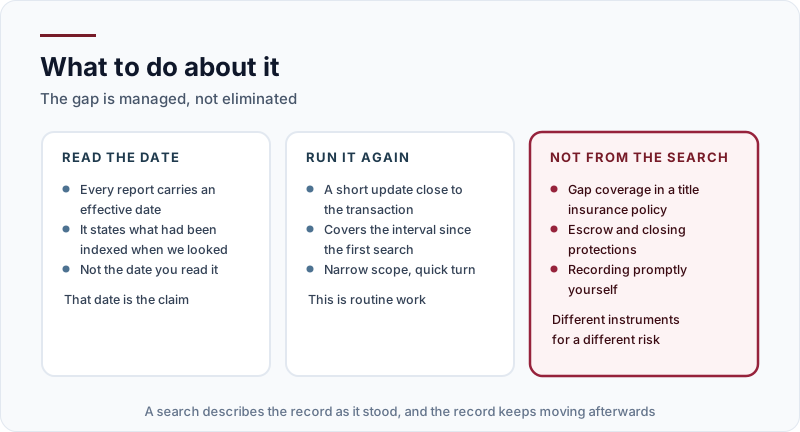
The first thing is to read the effective date. Every report carries one, and it is a statement about what had been indexed at the moment we looked rather than about the day you happen to be reading it. That is the subject of why a search has an effective date.
The second is to run the search again close to the transaction. A short update covering the interval is routine, narrow and quick, and it is the standard answer to a stale report.
The third is to recognize which risks belong somewhere else. Gap coverage in a title insurance policy, escrow and closing protections, and the simple discipline of recording your own instrument promptly are different tools for a different part of the problem. A search is a description of the record, not a guarantee about the future, which is the distinction drawn in what a title search is not.
The takeaway
A report describes what had been recorded and indexed in that county as of its effective date. The record keeps moving afterwards, the lag between the two varies from office to office, and no search reaches a document that has not yet been indexed anywhere. Find the property that runs your search, or tell us what you are trying to establish and when and we will point you at the right one before anything is ordered.