

· AFX Research, LLC
Why the Assessor and the Recorder Answer Different Questions
Two county offices, two different jobs, and why the parcel number on a tax bill is an administrative label rather than a statement about who owns the land.
Table of Contents
Most property questions that come back with a confidently wrong answer were asked at the wrong counter. The two offices sit in the same building, they both hold information about the same piece of ground, and they were built to do entirely different jobs. Knowing which one holds your answer saves more time than any amount of searching, and it explains a great deal of the confusion people arrive with.
What each office was built to do
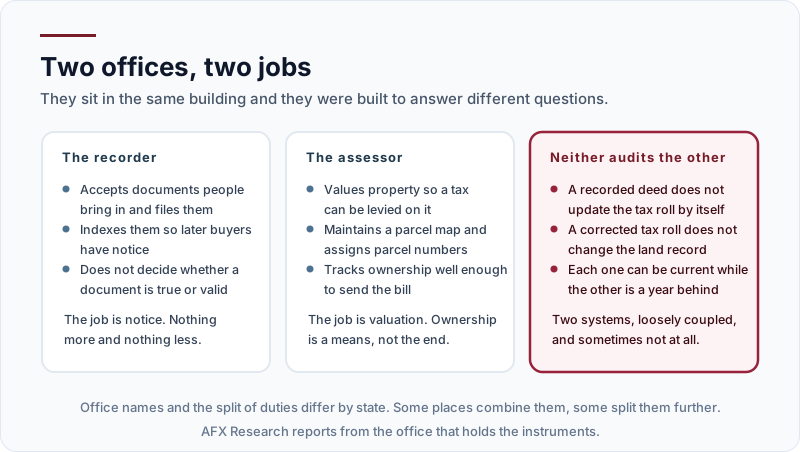
The recorder accepts documents that people bring in and files them so later buyers have notice. That is the whole job. It does not decide whether a deed is valid, whether the signer had authority, or whether what the document says is true, which is the point our note on how a document becomes a public record works through.
The assessor values property so a tax can be levied on it. To do that it maintains a parcel map, assigns parcel numbers, and tracks ownership well enough to send the bill to someone who will pay it. Ownership is a means to the valuation, not the purpose of the office.
Neither one audits the other. A recorded deed does not update the tax roll by itself in most places, a corrected roll does not change the land record anywhere, and each can be perfectly current while the other is a year behind.
Which office holds your answer
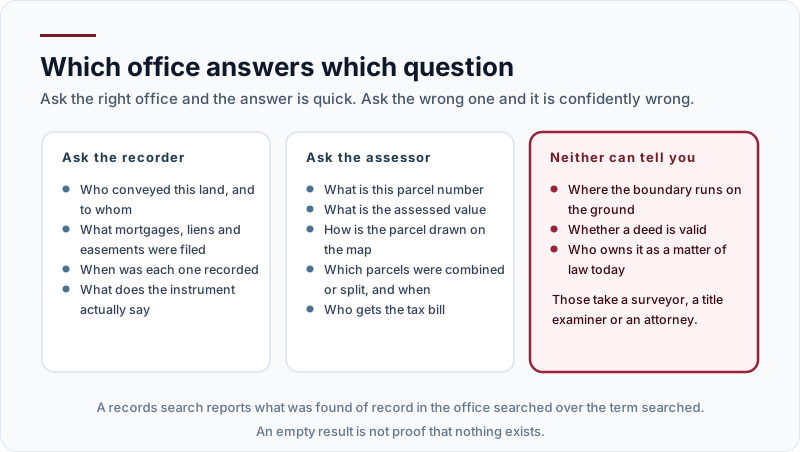
Ask the recorder who conveyed the land and to whom, what mortgages and easements were filed against it, when each was recorded, and what the instrument actually says. Ask the assessor for the parcel number, the assessed value, how the parcel is drawn, which parcels were combined or split and when, and who receives the bill.
Ask neither where the boundary runs on the ground, whether a deed is valid, or who owns the property as a matter of law today. Those need a surveyor, a title examiner or an attorney, and a records search that implied otherwise would be overselling itself — a line we hold to in what a title search is not.
Why they disagree
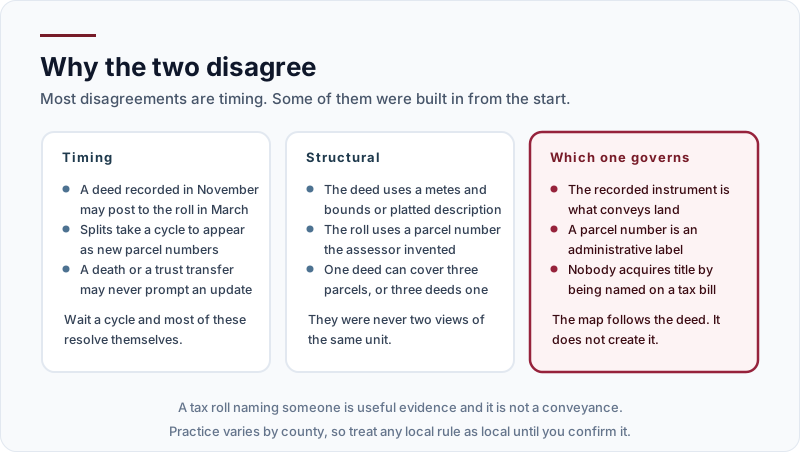
Most disagreements are timing. A deed recorded in November may not post to the roll until spring, a lot split takes a cycle to appear as new parcel numbers, and a transfer into a family trust may never prompt an update at all because nobody asked for one.
Some of it is structural. The deed describes the land by metes and bounds or by lot and block. The roll organizes it by a parcel number the assessor invented for administrative convenience. One deed can cover three parcels and three deeds can cover one, so the two were never two views of the same unit. That mismatch is the same one behind why one property can have several addresses.
When they conflict, the recorded instrument governs. A parcel number is a label, a tax roll naming someone is evidence rather than a conveyance, and nobody has ever acquired title by appearing on a tax bill. The map follows the deed.
Where the split bites hardest
Three situations turn this from a curiosity into a real problem.
The first is a property that changed shape. Combine two lots or split one, and for a period the roll and the record describe different things. An order placed against the new parcel number can miss instruments recorded against the old legal description, which is why a careful search starts from the description in the deed rather than from the number on the bill.
The second is a property held in an entity or a trust. The roll carries whoever the assessor last had reason to list, often a name several transfers old. Treating that as current ownership is how a search ends up run against the wrong person.
The third is land with no mailing address and no building on it. The assessor still has a parcel number because something has to be taxed, but the only description reaching the recorder is the one in the conveyance, and it may not have been resurveyed since the 1920s. How land is identified in the record covers what that description is actually made of.
The takeaway
Office names and the split of duties vary by state, so treat any local arrangement as local until you confirm it. What holds everywhere is the division of labor. One office exists to give notice of what was filed and the other exists to raise revenue, and a question aimed at the wrong one will usually still get an answer. Find the property that runs your search, or tell us what you are trying to establish and we will point you at the right one before anything is ordered.