

· AFX Research, LLC
What a Search Does With a Document That Was Later Undone
Why nothing is ever deleted from a land record, the several ways a filing stops having effect, and what a report should show when both documents are still there.
Table of Contents
People expect a released mortgage to vanish. It does not. A land record is cumulative, which means a filing that has been paid off, corrected, cancelled by a court or simply allowed to lapse is still sitting in the index exactly where it always was, and a second document has been added on top of it. Understanding that is most of what separates a report that reads cleanly from one that looks alarming. The mechanics of how anything gets in there in the first place are in our note on how a document becomes a public record.
Four ways a filing is undone
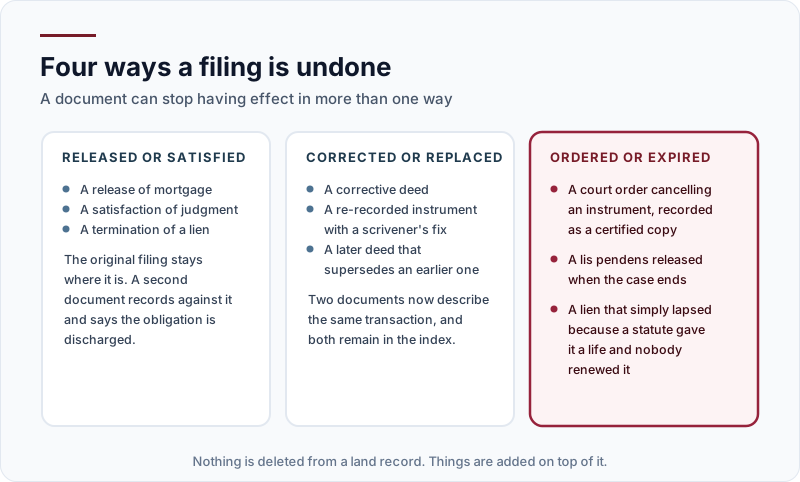
The first family is release. A release of mortgage, a satisfaction of judgment, a termination of a lien. The original filing stays put and a second document records against it saying the obligation is discharged.
The second is correction. A corrective deed, a re-recorded instrument fixing a scrivener’s error, a later deed that supersedes an earlier one. Now two documents describe the same transaction and both remain in the index, which is why our note on how a correction gets into the record spends its time on which of the pair controls.
The third is a court order, recorded as a certified copy, cancelling an instrument or releasing a lis pendens when the case ends. The fourth is expiry, where a lien simply lapsed because a statute gave it a life and nobody renewed it. That last one leaves no new document at all, which makes it the hardest of the four to see.
What stays in the index afterward
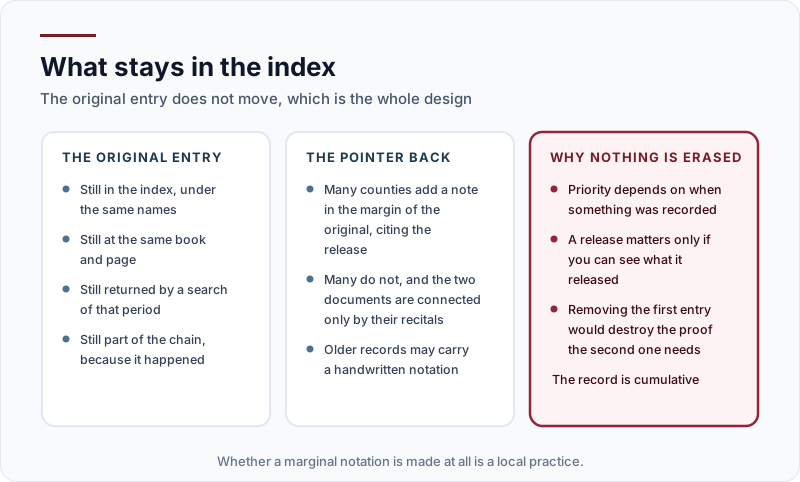
The original entry is still indexed under the same names, still at the same book and page, and still returned by a search of that period. It is still part of the chain, because it happened.
Whether the two documents are visibly connected depends on where you are. Many counties add a marginal notation to the original citing the release, and older records often carry a handwritten version of the same thing. Many counties do not, and the only link between the pair is a recital inside the second document naming the first.
The reason nothing is erased is structural. Priority depends on when something was recorded, a release matters only if you can see what it released, and removing the first entry would destroy the proof the second one needs. The record keeps its history because the history is the point, which is the same argument behind our note on how long a recorded document stays in force.
How a report handles the pair
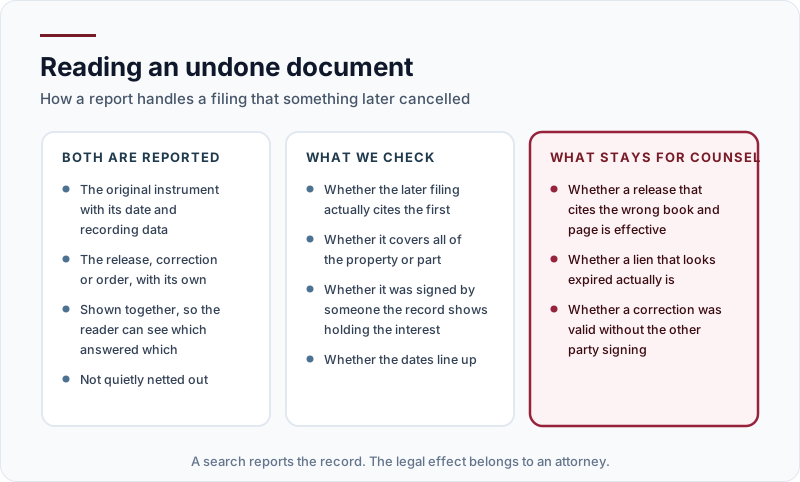
Both documents get reported. The original with its date and recording data, the release or correction or order with its own, shown together so a reader can see which answered which. Netting them out quietly would hide the one fact a reviewer most needs, which is whether the answer is actually complete.
What gets checked is the join. Whether the later filing cites the first, and cites it correctly. Whether it covers all of the property or only part of it. Whether it was signed by someone the record shows holding the interest. Whether the dates make sense.
What stays open belongs to counsel. Whether a release citing the wrong book and page is effective. Whether a lien that looks expired actually is, which turns on a statute rather than on the record. Whether a correction was valid without the other party signing. Recording and indexing practice varies by county, a search reports what was found of record, and an empty result is not proof that nothing exists.
The takeaway
Expect to see the released mortgage in the report, and read the pair rather than the first line. The question is never whether an old filing is still visible. It is whether the document that answered it is there, whether it covers everything, and whether it says what it needed to say. Find the property that runs your search, or tell us what you are trying to establish and we will point you at the right one before anything is ordered.