

· AFX Research, LLC
What Happens When a Recording Office Digitizes Its Records
Online access is an enormous improvement and a slightly different record. Where the coverage starts, what the conversion introduced, and what stayed in the books.
Table of Contents
A county puts its land records online and everything about searching gets better at once. It also quietly creates a second record that is not quite the first one — an index somebody retyped, images that start in a particular year, and a set of books nobody scanned. None of that is a criticism of the project. It is simply a fact about what you are looking at when you search from a desk, and it shapes what a search can honestly claim. It is the modern version of the problem in searching property records online.
What digitizing changes
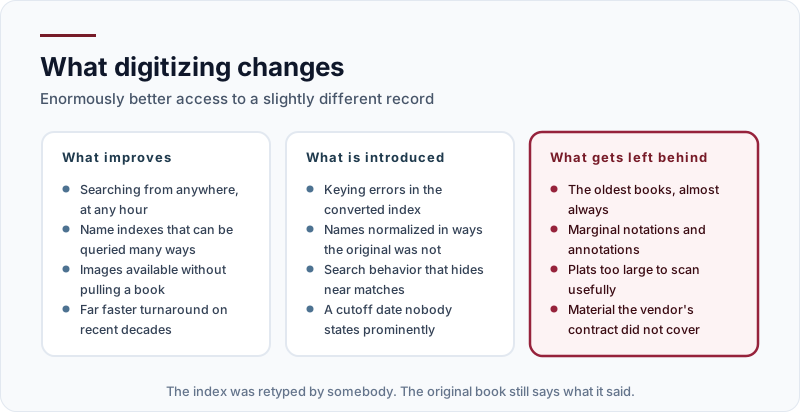
What improves is enormous and worth stating plainly. Searching from anywhere at any hour. Name indexes that can be queried in ways a bound book never allowed. Images available without pulling a volume. Turnaround on recent decades that is faster by an order of magnitude.
What is introduced comes with the conversion. The index was keyed by people or read by software, and both make errors. Names were frequently normalized — punctuation stripped, suffixes standardized, entity forms regularized — in ways the original entry was not, which means a search for the name as written may not match the name as stored. Search behavior hides near misses rather than offering them. And there is a cutoff date that the interface rarely announces.
What gets left behind is predictable. The oldest books, almost always, because they are the hardest and least used. Marginal notations and annotations, which are frequently where a release or a modification was recorded. Plats too large to scan usefully. And whatever the vendor’s contract did not cover.
The normalization point deserves an example, because it is the one that quietly breaks searches. A 1962 entry reading “Smith, Jno. B. & w.” may be stored as “SMITH JOHN B”, or as “SMITH JNO B”, or split into two records, depending on who did the conversion and what rules they were given. Each of those is a defensible choice and each one answers a different query. The book says what it always said.
Where the online record begins
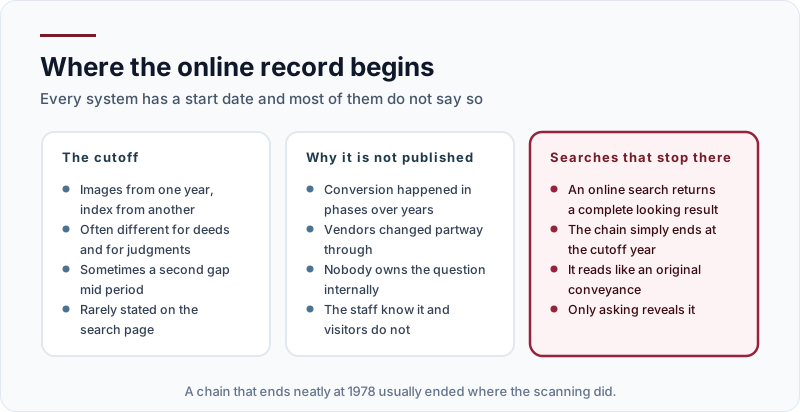
Every system has a start date and most of them do not say so. Images frequently begin in one year and the index in another. Deeds and judgments often differ. There is sometimes a second gap in the middle where a conversion phase was skipped or a vendor changed.
It is not published because nobody owns the question. Conversion happened in phases over years, staff turned over, and the people at the counter know the answer perfectly well while the search page says nothing.
The consequence is a search that stops without announcing it. An online search returns a complete-looking result, the chain simply ends at the cutoff year, and the earliest instrument reads like an original conveyance out of nowhere. That is indistinguishable from the genuine break discussed in what happens when a jurisdiction changes, and the only way to tell them apart is to know where the scanning stopped.
What to ask the office
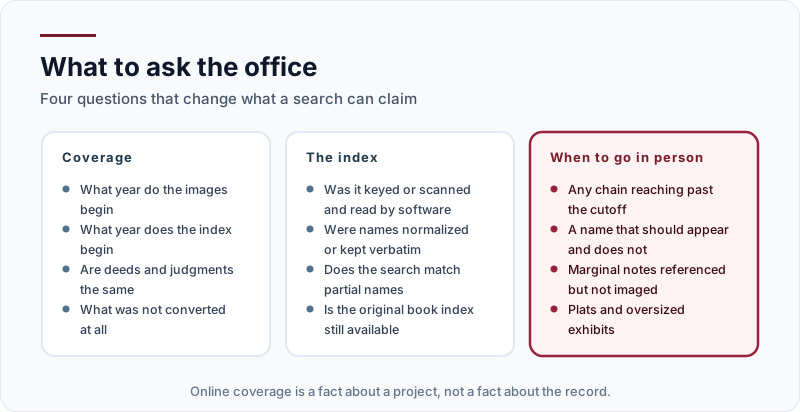
Four coverage questions. What year do the images begin. What year does the index begin. Are deeds and judgments the same. What was not converted at all.
Four index questions. Was it keyed by hand or read by software. Were names kept verbatim or normalized. Does the search match partial names. Is the original book index still available for comparison.
And the answer that follows from all of it. Any chain reaching past the cutoff needs somebody in the building, as does a name that ought to appear and does not, a marginal note referenced but not imaged, and anything oversized. That is the same conclusion reached in reading handwritten and archaic records, arriving from the technology side rather than the historical one.
The takeaway
Online coverage is a fact about a project rather than a fact about the record, and the two are easy to confuse because the interface looks complete either way. Ask where the images start, ask whether the index was normalized, and treat anything older than the cutoff as work that happens in person. Find the property that runs your search, or tell us how far back you need to go and we will tell you what that county actually makes possible.