

· AFX Research, LLC
What Recording Gives a Document That Signing Alone Does Not
Why a signed deed can be perfectly good and still lose to a later one, how the three recording rules differ, and what kinds of notice a search can never see.
Table of Contents
People assume recording is how a deed becomes real. It is not. A deed that is signed and delivered passes title the moment it changes hands, and the county has nothing to do with it. What recording does is different and in practice more important, because it tells the rest of the world something happened. That distinction explains most of what a title search is for, and it sits underneath our note on how a document becomes a public record.
Valid between two people, invisible to everyone else
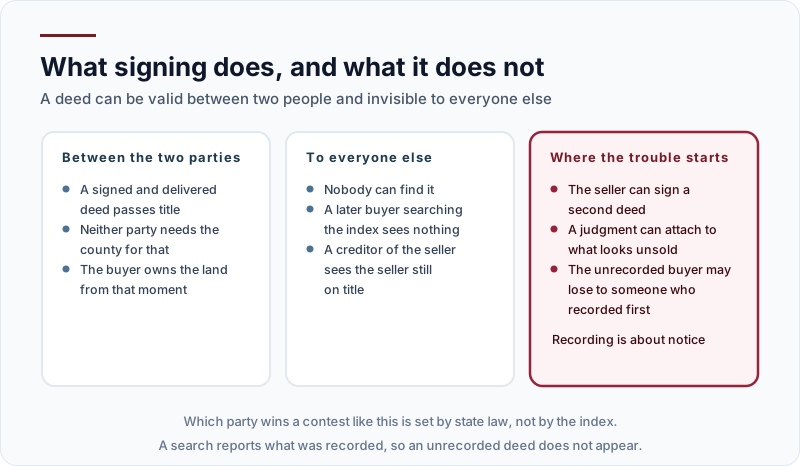
Between a seller and a buyer, the signed deed is the whole transaction. The buyer owns the land, and neither of them needs the recorder to confirm it.
To everyone else that deed does not exist. A later buyer searching the index finds the seller still on title. A creditor who wins a judgment against the seller sees property to attach. A lender sees an owner with something to pledge. None of them has any way to learn about a deed sitting in a drawer.
That gap is where most serious title problems begin. The seller can sign a second deed to somebody else, a lien can attach to land that was already sold, and the first buyer, who did everything right except record, can lose. Which of the two prevails is not decided by the index. It is decided by a statute in the state where the land sits.
Three ways states break a tie
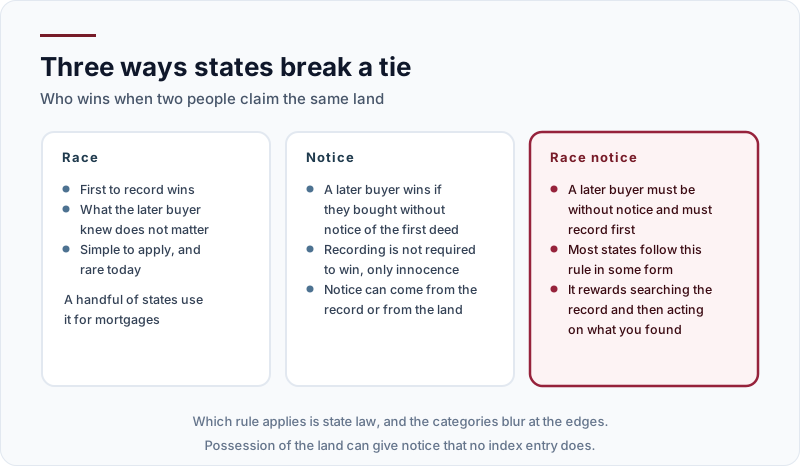
Under a race rule, the first to record wins and what anybody knew is irrelevant. It is the easiest rule to apply and the rarest, surviving mainly for mortgages in a few states.
Under a notice rule, a later buyer who purchased without notice of the earlier deed wins, whether or not they record. Innocence is the test rather than speed.
Under a race notice rule, the later buyer has to be without notice and has to record first. Most states follow some version of this, and it is the rule that makes searching worthwhile, because it rewards the party who looked at the record and then acted on what they found. The categories blur at the edges and the statutes are not interchangeable, which is part of why practice differs so much from state to state, as our note on how state law changes the same search describes.
What counts as notice
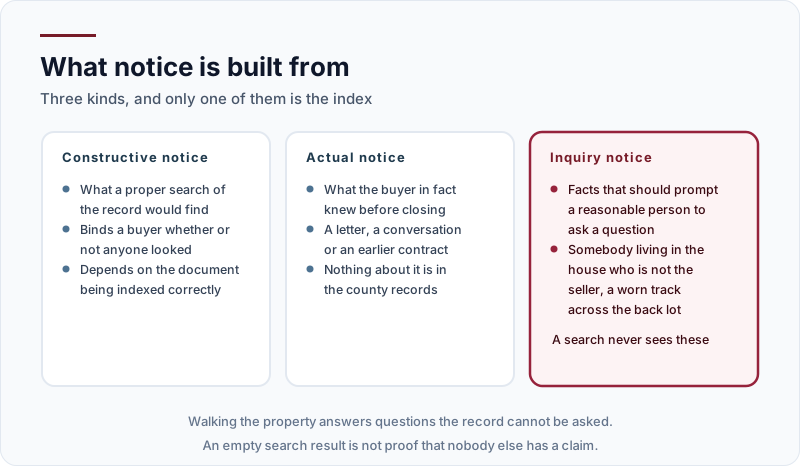
Constructive notice is what a proper search of the record would turn up. It binds a buyer whether or not anyone actually looked, which is the whole point of having an index, and it depends on the document having been indexed where a searcher would find it.
Actual notice is what the buyer in fact knew. A letter, a conversation, an earlier contract. None of it is in the county records, and none of it can be searched for.
Inquiry notice is the one people forget. Facts visible enough that a reasonable person would ask a question put the buyer on notice of whatever the question would have uncovered. Somebody living in the house who is not the seller, a worn track across the back of the lot, a fence that does not follow the line. A search cannot see any of that, which is why walking the property and reading the record are two different jobs, as our note on when the record and the ground disagree explains.
The takeaway
Signing moves title between two people. Recording publishes it, and publication is what protects it against everyone who comes later. A search tells you what was published, in the county where it was published, as of a stated date. It cannot tell you what was never recorded, and an empty result is not proof that nobody else has a claim. Find the property that runs your search, or tell us what you are trying to establish and we will point you at the right one before anything is ordered.